Ignore the Plebs, Collapse the Civilisation
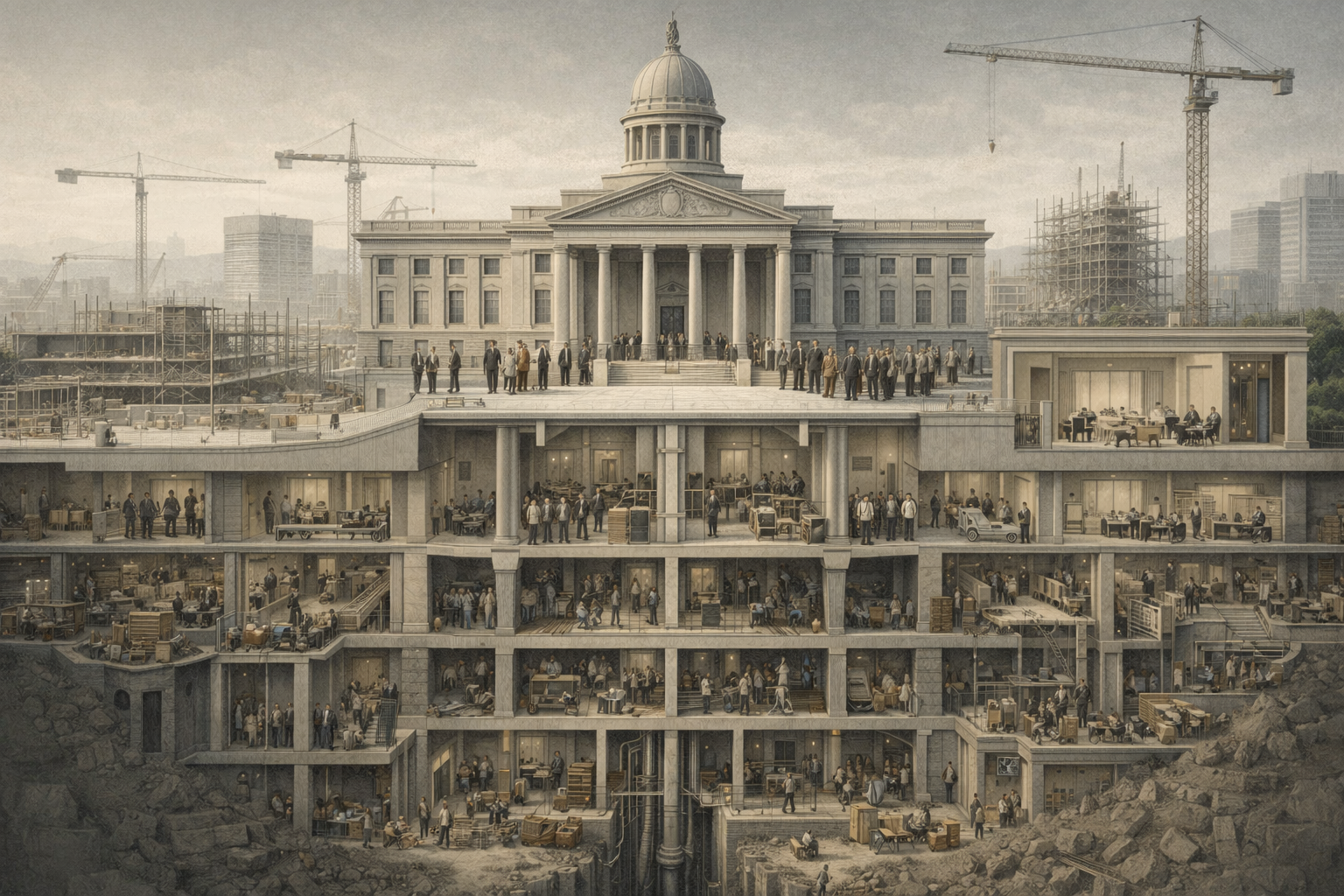
Why civilisational stability depends on dignity architecture, not charity.
Power Has Always Been a Structural Relationship
Across history, civilisations have been shaped by the dynamic between governing elites and the wider population. This relationship is not merely political. It is structural, cultural, and psychological.
Ancient Rome provides one of the clearest early models. Society was divided into distinct strata: patricians held inherited authority, senatorial figures governed strategically, equestrians exercised economic influence, and plebeians formed the functional backbone of daily life.
Despite lacking formal power, plebeians sustained the system. They farmed, built, fought, traded, and reproduced the continuity of the civilisation itself. Their exclusion from decision-making structures created recurring instability, forcing successive reforms.
This pattern has repeated throughout history. Civilisations do not collapse because elites exist. They collapse when elites fail to recognise the structural necessity of the population beneath them.
Civilisations Are Energy Conversion Systems
Every functioning society depends on the conversion of human energy into coordinated outcomes. Labour, creativity, participation, and belief form the real operating currency of civilisation.
When populations feel structurally excluded, that energy becomes fragmented. Productivity declines. Social cohesion weakens. Cultural trust deteriorates.
This is not primarily a moral failure. It is a systems failure.
Ignoring the plebs does not remove their influence. It destabilises the mechanism through which civilisation reproduces itself.
The issue is not whether elites should exist. The issue is whether systems are designed to integrate the capabilities of the many into meaningful contribution pathways.
Historical Power Structures Were Adaptive, Not Fixed
The Roman example illustrates an important point: hierarchical systems are rarely static. Over time, pragmatic necessity forces adaptation.
Military service in early Rome was not absent of broader participation, but it lacked clear structure. Obligation was shaped by status, influence, and tradition rather than a consistent system. Under Servius Tullius, this changed. His reforms reorganised military service around property ownership instead of lineage, creating a scalable model that aligned capacity with responsibility. This did not simply elevate the plebeians — it redistributed obligation and risk in a way that strengthened the state’s ability to endure.
Power structures evolve when their designers recognise systemic fragility.
Modern societies face a similar threshold. Traditional governance, economic, and cultural institutions were built for earlier conditions. As complexity increases, exclusion becomes progressively more destabilising.
Stability now depends on structural inclusion, not symbolic representation.
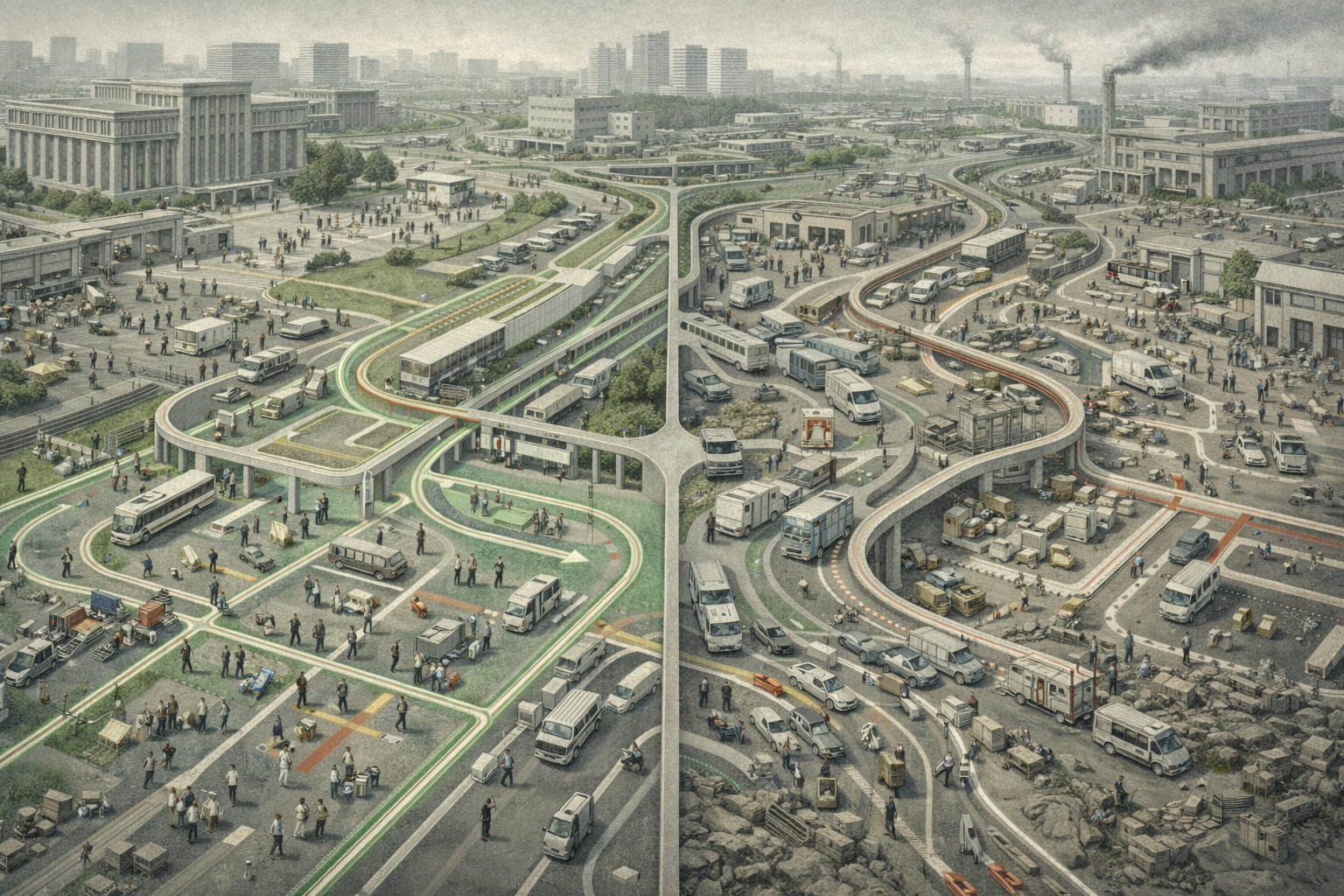
Dignity Is an Operational Variable
Dignity is often framed as a moral or philosophical concept. In reality, it functions as an operational variable within social systems.
When individuals perceive their contribution as meaningful, participation stabilises. When they perceive systemic disregard, disengagement accelerates.
This dynamic shapes economic resilience, political legitimacy, and cultural continuity.
The challenge is not simply to “care” about populations. It is to construct environments in which participation becomes structurally rewarding.
Dignity must be embedded into system design, not delegated to sentiment.
Principle-Based Frameworks as Stability Infrastructure
To translate human energy into sustainable outcomes, societies require principle-driven frameworks. These provide clarity of direction, continuity of decision-making, and alignment across sectors.
Such frameworks enable leadership to operate beyond reactionary cycles. They support long-term coordination between governance, economic activity, and cultural evolution.
Without principled structure, decision-making becomes opportunistic. Short-term gains undermine long-term coherence. Populations experience volatility rather than trajectory.
Frameworks do not eliminate hierarchy. They render hierarchy accountable to systemic purpose.
Misunderstanding Power Creates Cycles of Collapse
A persistent misconception in civilisational discourse is that instability arises primarily from the ambitions of the disadvantaged. Historical evidence suggests the opposite.
Collapse more often occurs when those in power fail to channel collective ambition productively.
Neglect breeds resentment. Overregulation without dignity breeds resistance. Symbolic inclusion without structural opportunity breeds cynicism.
Societies fracture when perception diverges from lived reality.
The lesson is not that equality must be absolute. It is that contribution pathways must be credible.

Cultural Narratives Shape Structural Outcomes
Civilisations are not sustained solely by policy or infrastructure. They are sustained by shared meaning.
Narratives determine how populations interpret their role within a collective trajectory. When individuals perceive themselves as expendable, disengagement becomes rational.
Conversely, when systems communicate purpose and participation clearly, resilience increases.
This is why cultural framing is not peripheral to development. It is foundational.
Meaning functions as a stabilising force within complex systems.
The Responsibility of System Designers
Every generation inherits institutional architectures shaped by prior conditions. The responsibility of system designers is to assess whether those architectures remain viable.
Modern complexity requires more adaptive frameworks than those built for industrial or agrarian eras.
Designing systems that integrate human potential is not ideological experimentation. It is civilisational maintenance.
Ignoring the plebs is not merely unjust. It is structurally unsustainable.
Civilisational Stability Is a Design Choice
Ultimately, the question is not whether societies value their populations rhetorically. The question is whether system design reflects that value operationally.
Dignity expressed through infrastructure, participation pathways, and cultural recognition produces stability.
Exclusion expressed through neglect, symbolic gestures, or fragmented opportunity produces fragility.
Civilisations endure when they convert human potential into coordinated progress. They decline when they treat that potential as expendable.
The future of stability lies not in eliminating hierarchy, but in ensuring that hierarchy serves systemic flourishing.