The Cost of Premature Judgement
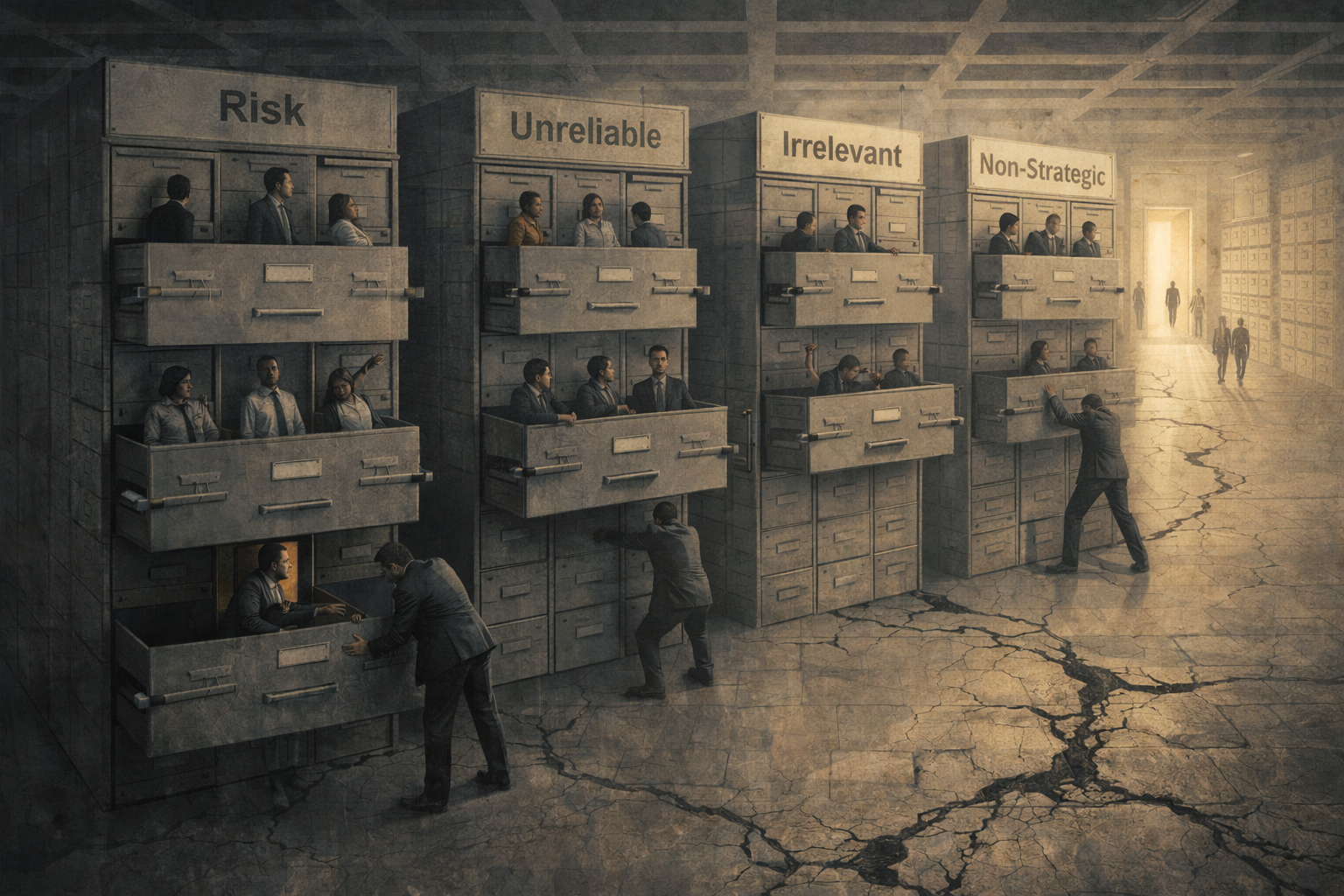
Why assumptions made too early become structural liabilities in leadership, culture, and strategy.
The Speed of Judgement Feels Like Strength
In fast-moving environments, judgement often masquerades as intelligence. The leader who decides quickly appears decisive. The organisation that forms a view early appears efficient. The culture that labels people, trends, or risks without hesitation appears confident in its own instincts.
But speed is not the same thing as clarity.
Many of the most damaging failures in leadership, business, and public life do not begin with a lack of intelligence. They begin with an incomplete picture being treated as a final one. A pattern is spotted too early. A person is interpreted too quickly. A market shift is dismissed before it is understood. From there, entire strategies begin forming around a distortion.
Premature judgement narrows possibility before reality has fully revealed itself. It closes off inquiry, hardens perception, and creates momentum around the wrong conclusion. What looks like certainty in the short term often becomes fragility over time.
Premature Judgement Is a Structural Process
This is not just a personal habit. It is a systemic mechanism.
Premature judgement usually follows a recognisable sequence. First, limited information creates an early impression. Second, that impression becomes a working narrative. Third, decisions begin forming around that narrative. Fourth, new evidence appears that complicates the original view. Finally, instead of recalibrating, the system defends the first conclusion because too much identity, power, or momentum has already been invested in it.
This is how misunderstanding becomes policy. It is how weak analysis becomes culture. It is how one shallow interpretation can quietly steer hiring, media framing, partnerships, governance choices, and public trust in the wrong direction.
The deeper problem is not the initial error. Human beings will always interpret reality imperfectly. The deeper problem is what happens when interpretation hardens into structure before it has earned that status.
When Assumptions Become Organising Forces
Once a judgement is embedded, it stops functioning as a thought and starts functioning as architecture.
An executive who assumes a new idea is too risky may underfund it. A team that assumes a colleague is difficult may interpret every interaction through that lens. A company that assumes old consumer habits will continue indefinitely may build its entire operating model around a disappearing reality.
At that point, the judgement is no longer passive. It is producing consequences.
Budgets shift. Opportunities disappear. Access is restricted. Innovation is slowed. People are sorted into categories they may never have deserved. The original assumption becomes self-reinforcing because the structure now filters incoming evidence in ways that protect the initial view.
This is one reason bad systems persist for so long. They do not merely make mistakes. They build defensive layers around those mistakes.

Rigidity Is Often Fear Wearing Professional Language
Rigid leadership is often misread as discipline. Sometimes it is nothing more than fear that has become formal.
A rigid system struggles to update itself because change threatens the authority of earlier decisions. To revise a position can feel, to insecure leadership, like admitting weakness. So instead of adapting, the system doubles down. It protects the image of certainty rather than the reality of truth.
This happens in organisations all the time. Existing models are defended because they are familiar. Emerging signals are minimised because they are inconvenient. New information is welcomed only if it supports the old frame.
Strategic adaptability is different. It does not mean becoming vague, indecisive, or endlessly reactive. It means holding principle steady while allowing interpretation to evolve. It means staying anchored without becoming frozen.
The strongest leaders are not the ones who never reconsider. They are the ones who can absorb new information without collapsing into ego defence.
Entire Industries Have Paid for Judging Too Soon
History is full of organisations that misread the future because they treated their current position as permanent.
Kodak helped develop the digital camera yet failed to take its implications seriously enough. Nokia underestimated the behavioural shift that smartphones would produce. Traditional media institutions often treated digital platforms as temporary distractions rather than civilisational changes in distribution, attention, and influence.
In each case, the issue was not a total absence of intelligence. The issue was interpretive rigidity. Early assumptions about what people would continue to value became stronger than the evidence showing what was actually changing.
Once that happens, decline can become difficult to reverse. A company may still have resources, reach, and brand recognition, yet be structurally trapped by yesterday’s judgement. It becomes too invested in protecting old coherence to build new relevance.
This is why premature judgement is expensive. It does not simply create error. It creates delay. And in strategic environments, delay compounds.
Misjudgement Does Not Only Damage Markets
The same mechanism operates in culture, institutions, and human relationships.
People are judged too soon in workplaces, families, communities, and public discourse every day. Someone is labelled unstable, difficult, naive, arrogant, unserious, or dangerous before the full context of their behaviour is understood. Once that label sticks, every future interaction is filtered through it.
This is how cultures become unjust without announcing themselves as unjust.
A person may be carrying trauma, overload, poor support, or a developmental gap that has never been properly met. A team member may be badly placed rather than incapable. A dissenter may be identifying structural weakness rather than causing disruption. But once the early narrative sets, discovery stops.
Premature judgement flattens complexity. It reduces living systems into simplistic categories. In doing so, it causes institutions to punish symptoms, overlook potential, and misread the real source of dysfunction.

The Real Opposite of Judgement Is Not Hesitation
The alternative is not passivity. It is disciplined observation.
Good leadership does not delay forever. Good leadership delays finality until reality has been studied well enough to warrant it. That means asking better questions before locking in conclusions.
What data is missing?
What assumptions are shaping this interpretation?
What context has not yet been surfaced?
What would disconfirm our current view?
Are we observing reality, or defending an early story about it?
These are not soft questions. They are strategic safeguards.
Organisations that build space for recalibration are not weaker. They are more durable. They do not confuse first impressions with finished truth. They understand that interpretation is part of design, and badly designed interpretation leads to badly designed systems.
Principle should be firm. Perception should remain examinable.
Flexibility Is a Discipline, Not a Mood
Real flexibility is not about constantly changing direction. It is about maintaining enough structural intelligence to adjust without losing coherence.
That requires a few things. It requires humility strong enough to revise. It requires patience strong enough to wait for clarity. It requires governance and decision-making processes that do not punish people for updating a view when new evidence appears. And it requires cultures where being right is not valued more than getting it right.
This kind of flexibility is difficult because it asks leaders to separate identity from interpretation. It asks institutions to prefer truth over optics. It asks cultures to mature beyond reflex and into reflection.
But without that discipline, systems become brittle. They mistake certainty for stability and end up shattering under conditions they could have adapted to.
The Future Will Belong to Systems That Can Recalibrate
The world is not becoming simpler. Markets are shifting faster. cultural signals mutate quickly. Public trust is unstable. technology changes behavioural norms before institutions have fully interpreted the implications. In that kind of environment, premature judgement becomes even more dangerous.
The systems that endure will not be the ones that react fastest in appearance. They will be the ones that can interpret deeply, update intelligently, and remain anchored while the environment changes around them.
That applies to leadership. It applies to culture. It applies to governance, media, education, economics, and human development.
When judgement arrives before understanding, distortion enters the structure. When observation is given time to mature, better architecture becomes possible.
The question is not whether we will interpret reality. We always will.
The question is whether we are disciplined enough to stop treating our first interpretation as the final one.