
A New Era Of
Human Response
Understand the situation. Reorganise the conditions. Restore human capacity.
The Human Response Era
We are now in the Human Response Era.
The previous era was defined by endless diagnosis and pathologising. Human responses to injury, pressure, contradiction and loss were artificially separated from the conditions that produced them, converted into disorders and returned to people as explanations of who they were. The more the system classified, the less it understood.
Over time, the language of defect displaced context, weakened personal authority and slowly eroded our understanding of what it means to be human.
The Human Response Era is defined by a remarkable change in the way we respond to human conditions. The person is no longer isolated as the site of the problem. Their thoughts, emotions, perceptions and behaviours are understood within the complete human situation through which they emerged.
Psychiatry no longer runs the response. Diagnosis gives way to understanding. Pathologising gives way to context. Managing visible distress gives way to reorganising the conditions producing or sustaining it.
The objective is no longer to make people compatible with systems that are themselves producing or sustaining harm, but to restore balance, authority and capacity across the whole of human life.
There is no separate realm called “mental health.” Human life is one indivisible system, expressed through the Seven Dimensions of Human Nature™: physical, spiritual, emotional, intellectual, social, occupational and environmental. Every dimension affects the others, and all are influenced by the person’s developmental history, relationships, economic circumstances, living conditions, culture and institutional environment. Distress, disruption and diminished capacity emerge through the interaction of these dimensions and conditions within the complete human situation.
A response capable of restoring human capacity must therefore act upon the whole system shaping the person’s life.
Human Response Architecture™ is a systems discipline conceived by Amos Ashley and developed through Global Stage Management™ to design the response systems of the Human Response Era. It is not a new therapy, a revised psychiatric treatment model or another service operating beneath the mental health umbrella. It establishes the coordinated architecture through which society investigates what happened, determines what continues to produce or sustain the distress, reorganises the surrounding conditions and restores the safety, authority, connection, opportunity, purpose and participation upon which human capacity depends.
The Post-Psychiatric Transition marks a civilisational departure from the diagnostic age. Psychiatry recedes as the authority through which human distress is interpreted, while systems organised around classification, pathologising and symptom management give way to Human Response Architecture. Humanity moves beyond naming and managing distress and assumes responsibility for understanding and transforming the conditions through which it arises.
This page brings together the foundation papers, system critiques, transition principles and frameworks defining the Human Response Era and giving form to its systems of response.
This is the Human Response Era: understand the situation, reorganise the conditions and restore human capacity.
The Foundation
There Is No Separate Realm Called Mental Health
A Framework for the Redesign of Human Distress, Recovery and Participation
This foundation paper establishes the complete human situation as the basis for understanding human distress. It rejects the separation of thought, emotion, perception and behaviour from the physical, developmental, relational, economic, cultural and institutional conditions through which they emerge—and challenges the diagnostic categories that convert those expressions into evidence of disorder located within the individual.
The paper examines diagnosis, labelling, environmental failure, cultural misalignment, fragmented institutions, failures to investigate possible physical or biological causes, chemical management and the systems that continue to reproduce the prevailing diagnosis-centred model of human response. It establishes the redesign objective: replace classification with context, containment with restoration, compliance with agency, and symptom suppression with the coordinated restoration of human capacity.
Amos Ashley presents the central proposition, systemic failures and redesign objective set out in the Foundation Paper.
THE FOUNDATION FILM
Companion Context Paper
Medication Must Never Become a Substitute for Understanding
Medication can alter how distress appears to a system without resolving the conditions a person continues to live through. This companion paper examines the difference between reducing the visible expression of distress and restoring the clarity, authority and capacity required for genuine recovery.
Medication, where used, must remain subordinate to the deeper work of understanding what happened, which injuries and pressures remain unresolved, and what conditions must change.
The Story Behind the Architecture
Human Response Architecture did not emerge from detached theory. It was shaped through direct exposure to the systems it now exists to redesign—and through the long reconstruction of a life those systems had reduced to diagnosis, behaviour and administrative record.

The Story That Gets Told
What happens to a person is only part of the story. The rest is written through what institutions choose to investigate, what they overlook, how they interpret the consequences and whether they act when the complete human situation becomes visible.
This entry brings together the video statement, formal statement, companion materials, related Field Notes and pathway for institutional consultation. The record does more than explain what happened. It reveals how institutional interpretation becomes consequence—and how direct exposure to those systems can be carried forward into response architecture.
Further Context
The Origin Story
How trauma, industry, collapse and recovery shaped the perspective from which Human Response Architecture emerged—and the purpose it now serves.
Experience & Expertise
The professional record spanning national broadcasting, production, creative execution and systems design, showing how that perspective has been developed and applied.
Human Response Architecture
The social order is part of the response.
Human conditions are produced across the whole of life. They are shaped not only through the body, development and relationships, but also through housing, income, work, education, culture, institutions, technology, environment and the distribution of security, authority and opportunity.
A response capable of restoring human capacity cannot stop at the person or at the services that receive them. It must reach into the systems arranging those conditions.
At its fullest scale, Human Response Architecture takes the social and systemic order of the planet as its design field. Economies, industries, governments, laws, institutions, technologies, cultures and built environments are examined according to the human conditions they produce—and reorganised where those conditions generate imbalance, damage, exclusion or diminished capacity.
The objective is not to place a better service beneath the existing order. It is to redesign the order itself around the requirements of human balance, development, authority, participation and capacity.
The objective is not global uniformity. It is global responsibility: every system becomes answerable for the conditions of life it creates.
Where damage has occurred, capacity is restored. Where harmful conditions remain active, they are changed. Where systems repeatedly reproduce the same human consequences, the systems themselves become the site of response.
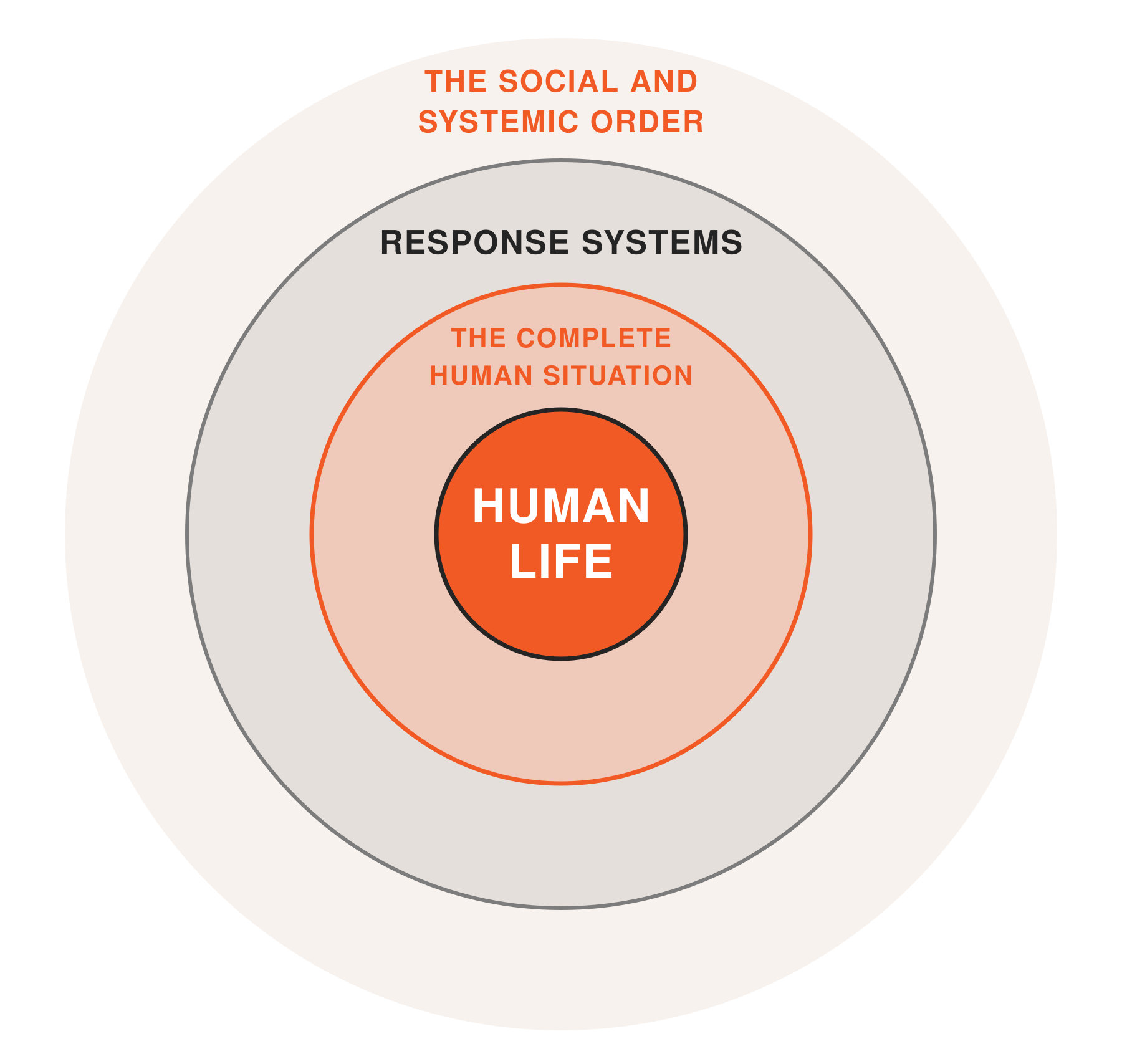
THE SCALE OF
HUMAN RESPONSE
ARCHITECTURE
At the centre is one indivisible human life, expressed through the Seven Dimensions of Human Nature™: physical, spiritual, emotional, intellectual, social, occupational and environmental. Each dimension affects the others; none can be understood or restored in isolation.
Human Life
The Complete Human Situation
Every life is shaped through developmental history, physical conditions, relationships, housing, income, work, culture, environment, meaning and institutional experience. Together, these form the complete human situation through which distress, stability, capacity and participation emerge.
Surrounding that situation are the systems society has built to respond: health, education, housing, employment, justice, welfare, family support, community development and institutional coordination. Their value depends not only on what each system does, but on whether they operate as one coherent response.
Response Systems
The Social and Systemic Order
Those systems operate within a larger order formed by economy, governance, law, industry, infrastructure, media, technology, culture, resource distribution and opportunity. Human Response Architecture extends to this scale because the conditions shaping human life cannot be separated from the structures that produce and distribute them across the planet.
Understand the situation.
Reorganise the conditions.
Restore human capacity.
Human distress becomes visible through a person, but the conditions producing or sustaining it may operate across every surrounding layer. Human Response Architecture follows those conditions to the scale at which they can be understood, reorganised and transformed.
Personal →
Interpersonal →
Local →
National →
Global →
HUMAN RESPONSE ARCHITECTURE FILM
Amos Ashley presents Human Response Architecture as one coherent civilisational shift—beginning with human nature and extending into every system, institution and environment shaping life.
One Architecture. Every Scale.
How the Architecture Operates
One operating method. Every scale.
01
Understand the situation
Establish the complete picture: what happened, what remains active, which dimensions are out of balance, what has been lost, what capacities remain intact and which conditions are producing or sustaining the visible outcome.
At wider scales, this requires tracing incentives, authority, resource flows, institutional gaps, cultural forces and the structures through which the same outcomes continue to be reproduced.
02
Reorganise the conditions
Change the arrangements carrying the problem. Repair immediate environments, coordinate sectors, redirect resources, redesign pathways, align institutional responsibility and alter the economic, cultural and governance structures repeatedly generating the same consequences.
The person is not reorganised around the system. The system is reorganised around the requirements of human life.
03
Restore human capacity
Rebuild safety, clarity, authority, connection, capability, opportunity, purpose and participation. Where capacity is already intact, protect and expand it.
The measure is not reduced disruption or improved compliance. It is whether people have become more capable of living, deciding, participating, contributing and shaping the conditions of their own lives.
Understand. Reorganise. Restore.
The same discipline applies within one life, across a community, through a nation and throughout the global order.
A Developed Foundation
Within Global Stage Management™, Human Response Architecture™ is a major applied architecture contained within the Seven Dimension Global Business Engine™. GSM’s existing systems provide HRA’s developed operating foundation and first build layer: a coordinated body of human, cultural, civic, economic and institutional design from which HRA’s wider methods, instruments and implementation structures can continue to expand.
These frameworks provide working components of Human Response Architecture. They do not define its limits.
Human and System Orientation
The Seven Dimension Global Business Engine™, Seven Dimensions of Human Nature™, GSM Comprehensive Multi-Tiered Cerebral Framework™, Map of Existence™ and Ethos Framework™ establish a multidimensional, scale-aware and principle-led basis for understanding human life and the systems surrounding it.
The Mind Bridge Card™, LensShift™, ReframeTool™ and Identity Uplift™ translate that orientation into practical tools for perspective, self-understanding, communication, decision-making and personal authority.
Personal Clarity and Agency
Development and Participation
The Redemptive System™ and Asset Uplift System™ replace punishment, exclusion and isolated intervention with development-first pathways supporting capability, reintegration, economic participation and sustained contribution.
Institutional and Environmental Coordination
Seamless Sync™, Trustcraft™, the Unified Response & Community Growth Framework™, Civic Cells™, the Global Integrity Mandate™ and Windland™ provide mechanisms for cross-sector integration, trust restoration, ethical continuity, community response and place-based systems development.
Human Response Architecture operates both at the level of the person and across the conditions surrounding them. Tools at the personal scale can restore clarity, strengthen agency and expand thought beyond the immediate situation, helping a person recognise when a matter extends beyond their individual control. But recognising the wider picture is not the same as changing it. Where housing, income, work, relationships, institutions, culture or environment are producing or sustaining harm, those conditions must also be reorganised. Human Response Architecture connects personal orientation with the structural transformation of the systems shaping human life.
Applied at the Personal Scale
The Mind Bridge Card™ demonstrates how Human Response Architecture can become immediately usable at the personal scale. It helps a person orient across the Seven Dimensions of Human Nature™, recognise the scale at which a situation is operating and reconnect thought to principle.
It is one applied tool within the wider architecture—not the architecture itself.
The Mind Bridge Card™
Human Response Architecture begins wherever human capacity has been obstructed—and continues outward until the conditions required for its restoration have been established.
The Post-Psychiatric Transition
Psychiatry was never the final form of humanity’s response to distress. It was one historical attempt to interpret and manage human conditions through diagnosis, classification and intervention directed primarily at the individual. The Post-Psychiatric Transition names the civilisational movement beyond that governing model.
As the diagnostic age recedes, the functions and authority concentrated within psychiatric systems are separated and reassigned among the disciplines, sectors, public institutions and independent bodies properly responsible for them. Physical health, development, relationships, housing, income, work, education, justice, culture, community and institutional conduct become part of one coordinated response environment.
What replaces psychiatric authority is not another profession or institution claiming ownership of the person. It is distributed responsibility with identifiable accountability: each function is carried by the discipline, sector or public body equipped and lawfully authorised to perform it; an identifiable coordinating function holds the complete response together; and independent bodies review restrictions on rights and the exercise of public power.
From diagnosis-centred systems to integrated human response
This is not the reform of psychiatry. It is the displacement of the assumptions that made psychiatry appear necessary—and the construction of the systems capable of succeeding it.
The Governing Shift
The transition changes where society looks, what it acts upon, how responsibility is organised and what counts as restoration.
• Isolates the person
• Classifies expression
• Manages symptoms
• Divides services
• Measures compliance
• Returns people to existing conditions
Diagnostic Age
• Investigates the complete human situation
• Identifies what produced the distress
• Changes the conditions sustaining it
• Coordinates response systems
• Restores authority and capacity
• Reorganises conditions around human requirements
Human Response Era
The transition does not require existing services to disappear before successor systems are capable of assuming their functions. Existing institutional holders remain responsible while new disciplines, public structures and cross-sector pathways progressively build the capacity to understand the complete human situation, coordinate the required response, change the conditions sustaining harm and restore human capacity.
Each function must be assessed and, where required, retained, reformed, transferred, established or retired through a staged and lawful process.
Any rights-restricting intervention must address a specific and immediate danger and remain lawful, necessary, proportionate, least restrictive, time-limited and independently reviewable. Protection must not become permanent diagnostic ownership of the person.
Transitional Coexistence
Psychiatric dependence diminishes as society grows more capable of preventing developmental and environmental damage, investigating physical conditions, identifying pressures earlier, coordinating institutions, reorganising harmful environments and restoring capacity before crisis becomes entrenched.
Psychiatry is not displaced by declaration alone. Its necessity is progressively designed out through a more complete system of human response.
Designing Out the Need
POSITION PAPER
The Post-Psychiatric Transition
From diagnosis-centred systems to integrated human response
A concise position paper defining what civilisation is departing from, what replaces psychiatric authority, how transitional coexistence operates and how the need for psychiatric classification and management is progressively designed out.
Inside the paper
The Diagnostic Age
The Civilisational Departure
What Replaces Psychiatric Authority
The Transitional Period
Designing Out the Need for Psychiatry
The Human Response Era
Psychiatry was one phase in humanity’s attempt to respond to distress. The Post-Psychiatric Transition is the movement beyond it—and Human Response Architecture provides the common foundation from which the successor order is being designed and built.
The Post-Psychiatric Transition the movement beyond diagnosis-centred systems. The four documents that follow carry that movement into institutional form. Together, they define how public functions, authority, resources, protection, coordination and oversight can move lawfully into a successor order; examine the risk of new organising logic being absorbed into familiar institutional machinery; map the GSM structures through which Human Response Architecture is stewarded, developed and prepared for implementation; and establish the nomenclature required to distinguish fixed terminology, proposed successor-system structures and jurisdiction-specific public identities.
From Transition to Institutional Construction
The Human Response Architecture Institutional Succession Framework™
Next in the Main Series
Governance, authority and public-system implementation
Extends the transition into governance, authority and public-system implementation. It defines the institutional order required to receive and carry transferred functions with continuity, identifiable accountability, protected rights and independent review.
Companion Context Paper
How Change Gets Swallowed
Why integration must preserve the distinct operating logic of a new system rather than absorb it into familiar institutional machinery.
Examines a central implementation risk at the point where new architecture begins interacting with established institutions: the gradual reshaping of genuinely different organising logic into forms the existing system already knows how to operate. It distinguishes integration from absorption and explains why architectural autonomy must be preserved throughout both the transfer of responsibility and authority to public institutions and the implementation of the new system.
The Human Response Architecture™ Structural Guide
Companion Architectural Reference
GSM framework body, organisational responsibilities, implementation pathways and public-system boundaries
Maps HRA’s position within GSM, the structures responsible for stewardship, methodological development, institutional implementation and demonstration, and the boundaries between GSM’s responsibilities and the exercise of lawful public authority.
Human Response Public-System Nomenclature Schedule
Supporting Implementation Schedule
Provisional institutional, service, portal, programme and public-interface nomenclature
Provides the consolidated naming architecture for Human Response Architecture’s fixed terminology, proposed successor-system structures and jurisdiction-specific public identities. It identifies which terms are stewarded by GSM, which names are proposed for government consideration and which remain subject to determination by adopting jurisdictions.
Essential Reading
Seven papers extending the foundation from human interpretation to system design and transition.
The Foundation establishes the central proposition. These seven papers extend it through intervention, perception, institutional exclusion, human development, system architecture, social reproduction and the cultural leadership of transition.
Read in sequence, they show how a more complete response begins with seeing one person accurately, continues outward into the conditions and systems shaping human life, and reaches the leadership required to move new systems into practice.
01 • CP0038
Medication Must Never Become a Substitute for Understanding
Medication can change the presentation visible to a system without resolving the person’s experience or the conditions affecting them. This paper makes intervention answerable to understanding and asks whether the response restores clarity, authority and agency—or merely makes distress easier for the system to process.
02 • CP0004
Seeing Through the Damage: Why “Bad People” Aren’t What We Think
Harmful behaviour can be real without being the whole identity of the person expressing it. This paper looks beneath trauma, survival patterns and visible damage to the human capacity still present—and to the structured pathways through which that capacity can be restored and expressed in life and contribution.
03 • CP0009
The People the System Finds Inconvenient
People described as “too complex”, “non-compliant” or “hard to help” often reveal the limits of the systems processing them. This paper treats complexity as information: a guide to where public frameworks must expand if they are to hold the full range of human life.
04 • CP0017
We Don’t Need More Heroes—We Need More Gardeners
Human growth is environmental. This paper shifts the response from judging visible outcomes to cultivating the conditions through which people can develop—support, structure, safety, continuity and care built as shared infrastructure rather than left to isolated individuals.
05 • CP0031
Why Reform Fails Without Architecture
Reform adjusts what a system does; architecture examines what the system is designed to produce. This paper shows why fragmented interventions redistribute pressure instead of resolving its source—and why lasting change depends upon alignment between conditions, incentives, responsibility and capacity.
06 • CP0035
Why Societies Produce the Very Dysfunction They Fear
Exclusion, blocked participation and narrow definitions of value do not merely leave human potential unused; they generate predictable forms of withdrawal, instability and fragmentation. This paper follows that cycle upstream and shows how belonging, participation and pathways for contribution alter the conditions through which it is reproduced.
Leadership & Transition
07 • CP0037
The Future Rarely Looks Familiar at First
New systems are often assessed through the assumptions of the systems they exist to move beyond. This paper examines the cultural responsibility of transition: recognising value before familiarity arrives, giving unfamiliar models room to develop and helping institutional leadership see what existing categories cannot yet hold.
The more completely we understand what produces human conditions, the less defensible it becomes to keep acting only upon the person.
Continue Through Beyond the Surface
The wider collection carries these principles across human development, society, culture, systems architecture and future design.
For Universities, Institutions and Public Leadership
The public foundations of Human Response Architecture are available for institutional examination and interdisciplinary dialogue, with future research, development and application extending across:
Universities and research institutions
Government and public systems
Medical and community environments
Education, justice, housing and human development
Media and cultural institutions
The next stage is the formation of partnerships capable of strengthening the research foundations, defining meaningful measures of human capacity, developing pilot environments and translating the architecture into practical public-system application.
Formal research, evaluation and institutional development will expand as partnerships and operational capacity are established and investment is secured.
Universities, institutions and public leaders are invited to engage with Amos Ashley and Global Stage Management™ in shaping that development.
Institutional engagement begins with an exploratory conversation. Any examination, research or development extending beyond the public materials proceeds through an agreed and appropriately resourced pathway covering scope, confidentiality, intellectual property, attribution, publication, intended use and ownership of any new work.
We cannot always wait for leadership to come from the top. Sometimes those who can see the shift must help the top see.
When using the contact form for this pathway, please enter “Human Response Architecture — Institutional Pathway” in the subject field.
A separate confidential commercial pathway for discussing institutional and public-system matters directly with Amos Ashley.
Seeing What Others Don’t — Executive Advisory
The perspective behind Human Response Architecture is also available through a separate confidential advisory pathway for leaders, founders, investors, private entities, organisations and institutions facing a complex decision, structural problem, emerging opportunity or unresolved situation.
Amos Ashley provides independent perspective, structural diagnosis, strategic reframing, pattern recognition and long-range judgement where existing advice or internal frames have not produced sufficient clarity.
12
HANDSHAKES
A DIRECT INVITATION
Amos Ashley introduces Twelve Handshakes—the invitation to gain confidential, priority access to his perspective within a retained advisory practice limited to twelve active relationships.
Twelve Handshakes
The retained advisory is personally delivered by Amos Ashley and limited to no more than twelve Retained Executive Advisory Relationships active at any one time. New retained relationships are established progressively to preserve the personal access, priority, continuity and quality the retainer is designed to provide.
Confidential Strategic Perspective Reviews are accepted separately, in limited numbers and subject to scope and availability. A Review does not occupy or reserve one of the twelve retained places. If a Review later leads to a retained relationship, a place is secured only when a Retained Executive Advisory Agreement is confirmed.
Limited Retained Intake
The engagement applies the perspective behind the work to the client’s own context. It does not transfer ownership of, or unrestricted access to, the broader GSM and Amos Ashley body of work.
Continue into the Wider GSM Environment
Selected Focus provides access to GSM’s current priorities, stakeholder pathways, featured briefings and the broader body of work under development.
Supporting the Work
Human Response Architecture is being developed through a founder-led platform without a dedicated institutional budget, research team or funded development environment.
Financial and strategic support creates the conditions required to protect and extend the framework body, complete its documentation, develop institutional partnerships, establish formal research and evaluation pathways, and prepare the architecture for pilot application.
Those who recognise the importance of this transition can help build the capacity required to carry it forward.