How Change Gets Swallowed
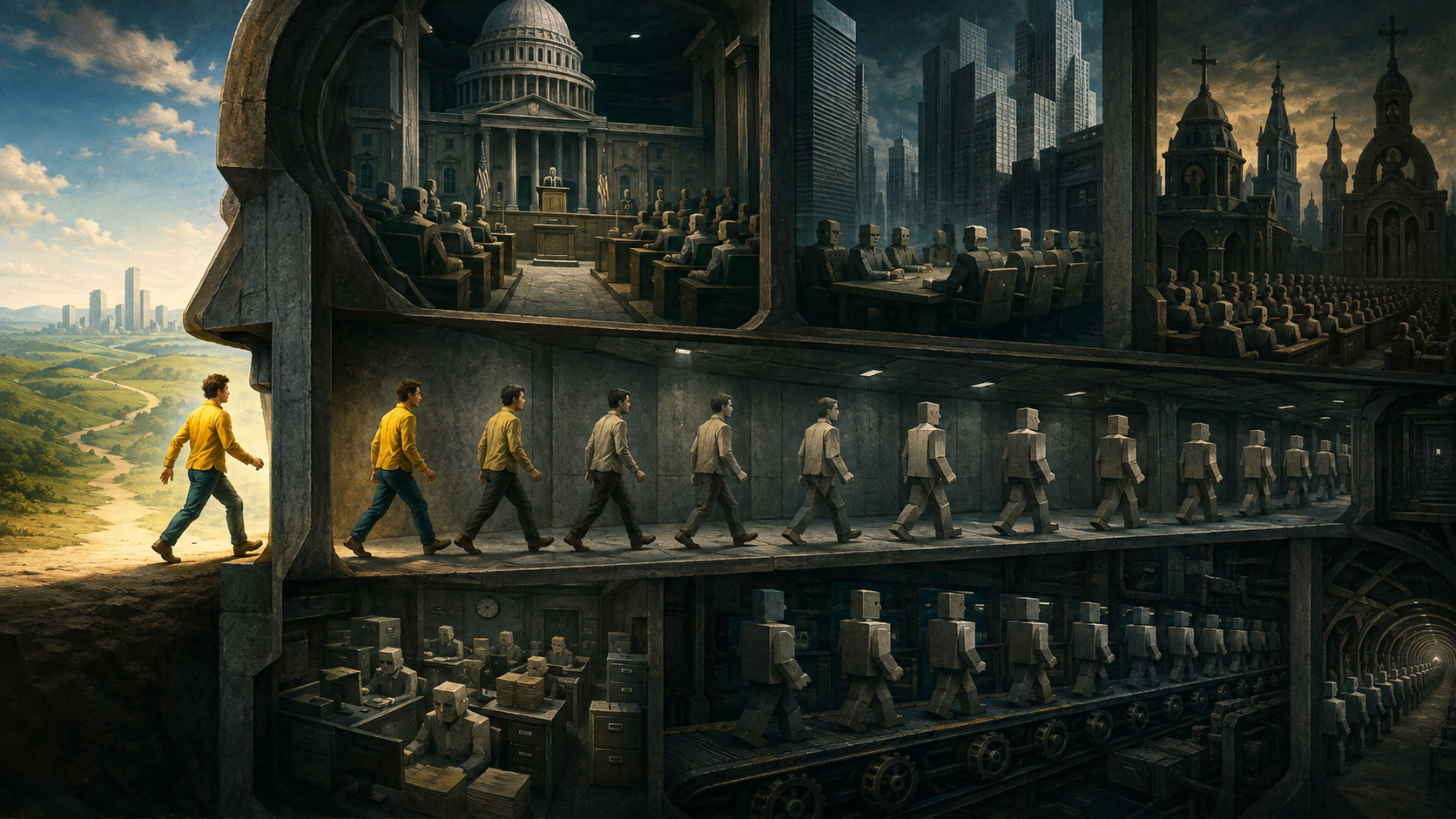
People enter systems to change them. Too often, the system changes them first.
The Pattern Everybody Knows
We have seen this pattern so many times that most people barely question it anymore.
Someone enters politics determined to change how power works. Someone starts a business because they are sick of how business is usually done. Someone enters a religious institution wanting to restore humanity to something that has become rigid. Someone creates a new social or economic model because the current one keeps producing outcomes nobody seems able to resolve.
Then the system gets hold of them.
They learn which compromises are considered necessary, which language creates legitimacy, which people need to be kept comfortable, which assumptions are not supposed to be challenged, and which parts of the original vision will have to wait until conditions are supposedly more favourable.
Nothing dramatic has to happen. There may be no betrayal, corruption or single moment when the person gives up. The system simply begins shaping the person who entered it.
A few years later, they may still believe they are changing the system while increasingly reproducing it. Others recognise what has happened and become disillusioned. Some abandon the original cause altogether and redirect their energy towards status, influence, control or advancement within the very structure they once wanted to change.
We know this happens.
The harder question is why we keep creating the conditions that allow it to happen.
Good Intentions Are Not Enough
Whether we place faith in good intentions or distrust them from the outset, intention alone is not enough to protect change from the system around it.
People can enter an institution with enormous integrity and still become conditioned by its incentives. Leaders can genuinely want different outcomes while making decisions through structures designed to preserve existing ones. Organisations can adopt new language while leaving the machinery underneath almost untouched.
Systems do not need bad intentions to produce bad outcomes. A system can keep producing the same results even when the people inside it mean well. Its rules, incentives, hierarchies, budgets, habits, professional norms and definitions of success continue operating regardless of what any individual hoped to accomplish when they arrived.
That is why good people can become agents of systems they once questioned.
The system did not need to defeat them. It only needed to make adapting to its rules the price of continued participation.
Absorption Rarely Looks Like Defeat
The danger is that absorption often looks completely reasonable while it is happening.
A new idea enters the room and people ask for it to be translated into familiar language. At first, the adjustments seem harmless. Then it is asked to fit an existing category. Then an existing process. Then an existing funding stream. Then an existing governance arrangement. Then an existing measure of success.
Each adjustment can appear minor.
Eventually the new thing still exists, but only in a form the existing system already knows how to recognise.
Its name may survive. Its language may survive. People may even congratulate themselves for embracing innovation.
But underneath, the new idea is no longer operating by its original logic.
What began as something capable of producing a different result has been reshaped until it operates through the same assumptions that produced the very situation it was introduced to change.
That is how change gets swallowed without anybody having to openly oppose it.

Familiarity Has Enormous Gravity
Existing systems naturally pull unfamiliar things towards what they already understand.
That is not always malicious. Familiar structures feel safer. They are easier to explain, approve, fund, measure and defend. They carry established language, recognised authority and known procedures. When something new does not fit those structures, the instinct is often to reshape the new thing rather than ask what in the existing structure should be kept, changed, removed or added to make room for it.
This is where the brick wall appears.
The new idea is told to become more realistic, when “realistic” really means more familiar. It is told to become practical, when “practical” means fitting the tools already available. It is told to work within the system, when working within the system quietly becomes accepting the system’s limits as the limits of possibility.
That tendency can occur anywhere. It can happen around an institution, a community, a family, a workplace, a movement, a public service, or something as small as one person bringing an unfamiliar idea into a familiar environment.
The scale changes. The dynamic does not.
And repeated across enough parts of human life, that dynamic becomes one of the greatest barriers to progress: new energy enters, the existing system absorbs it, and what was meant to move us forward is pulled back toward the pattern it was introduced to change.
It is the nightmare of progress — change enters the system, the system turns it back into more of the same, and we all pay for that.
Integration Is Not the Same as Absorption
The answer is not to keep new things safely outside existing systems forever. Anything useful eventually has to meet the world as it is.
It has to encounter existing people, structures, habits, rules, resources and realities. It has to translate. It has to cooperate. It has to adapt where adaptation improves the work.
That is integration.
Integration allows something new to connect without requiring it to stop being new.
Absorption begins when connection becomes conditional on surrender. The new idea can participate, but only once it has adopted the old assumptions. The new structure can enter, but only once it fits the old architecture. The unfamiliar can be accepted, but only after enough of its difference has been removed.
That is not integration.
That is the old system reproducing itself through the new thing.
The challenge is not to protect difference for the sake of difference. It is to protect the part of the difference that makes another outcome possible.
Understanding Needs Space to Form
If we want genuinely new things to survive contact with existing systems, we have to become better at holding space for what we do not yet fully understand.
That requires discipline.
Unfamiliarity is not evidence of failure. Nor is slow acceptance. Some changes are adopted quickly because they barely disturb the existing order. Others require years or decades because they challenge assumptions that have been embedded across generations. The time it takes for a culture to understand something tells us very little, by itself, about whether that thing has value.
What matters is whether the new idea can be examined, tested, challenged and properly understood without first being forced into familiar terms simply to survive. Its future should not depend on reaching some arbitrary point where the existing system decides it has waited long enough. The burden is not on the new thing to become comfortable to the old system within a timetable the old system controls.
If a shift is large enough, protecting the space for it to mature may itself become part of the work of change.
That space is often where the future is either protected or killed. Closing something down because it does not yet fit is easy. The harder discipline is preserving enough room for understanding to develop before unfamiliarity is mistaken for failure. Sometimes leadership means recognising that the surrounding system has not yet caught up with what it is being asked to understand.

The Present Cannot Be the Judge of the Entire Future
There is another reason this matters.
Existing systems naturally design from the present forward. They begin with what currently exists and ask how much change can be accommodated without disturbing too much of it.
That approach has value, but it also creates a trap.
If the present system helped create the problem, then the present system cannot always be allowed to define the boundaries of the solution.
Sometimes we have to reverse the direction.
Start with the resolved condition.
What does it look like when the problem is no longer being reproduced? What becomes possible? What relationships need to exist? What structures are still useful? What no longer serves a purpose? What would people actually experience if the outcome were working?
Then work backwards towards the present.
That keeps the destination alive while practical decisions are being made. It prevents every new possibility from being reduced to whatever the current system can already imagine.
Without that anchor, the future gets negotiated away one “reasonable” compromise at a time.
Both Sides Carry Responsibility
Responsibility does not sit on one side.
People inside established structures have to resist the reflex to own, categorise, control or neutralise everything unfamiliar that comes near them. They have to recognise when their expertise is genuinely helping something develop and when it is simply forcing that thing back into familiar territory.
Those introducing something new carry responsibilities of their own. They have to know what can change and what cannot. They have to remain open to challenge without surrendering the reason the work exists. They have to build bridges without handing over the foundations.
This is not about stubbornness.
It is about knowing the difference between refinement and erasure.
Change survives when both sides are willing to do something more difficult than either rejection or takeover: enter a relationship without demanding that one side disappear.
Breaking the Absorption Cycle
Everyone says they want change.
People are tired of the same political cycles, the same institutional failures, the same economic pressures, and the same social problems being announced, debated, funded and rediscovered without ever truly going away.
The frustration is real because the pattern is real.
New energy enters. The system redirects it. The original difference weakens. The same machinery keeps running. Another generation arrives and wonders why nothing fundamentally changed.
Changing the people inside the machinery is not enough if the machinery continues shaping what those people are able to do. The deeper task is recognising the forces that pull unfamiliar ideas back toward familiar structures, and building enough protection around what is genuinely different for that difference to remain functional.
That means recognising absorption while it is happening. It means allowing translation without demanding conformity. It means distinguishing useful adaptation from the gradual loss of the very logic that made a new approach necessary. It also means keeping the resolved outcome in view, so present structures do not become the automatic boundary of what the future is allowed to become.
Integration without absorption is therefore not simply a matter of cooperation. It is a discipline of change.
Without it, new energy will continue entering old systems only to be converted back into familiar forms.
And if that pattern continues unchecked, we should expect the same outcomes to keep returning — no matter how often we rename the programs, replace the people, restructure the organisations or promise that this time will be different.