Feeding the Sky: Stewardship That Returns Energy to the Region
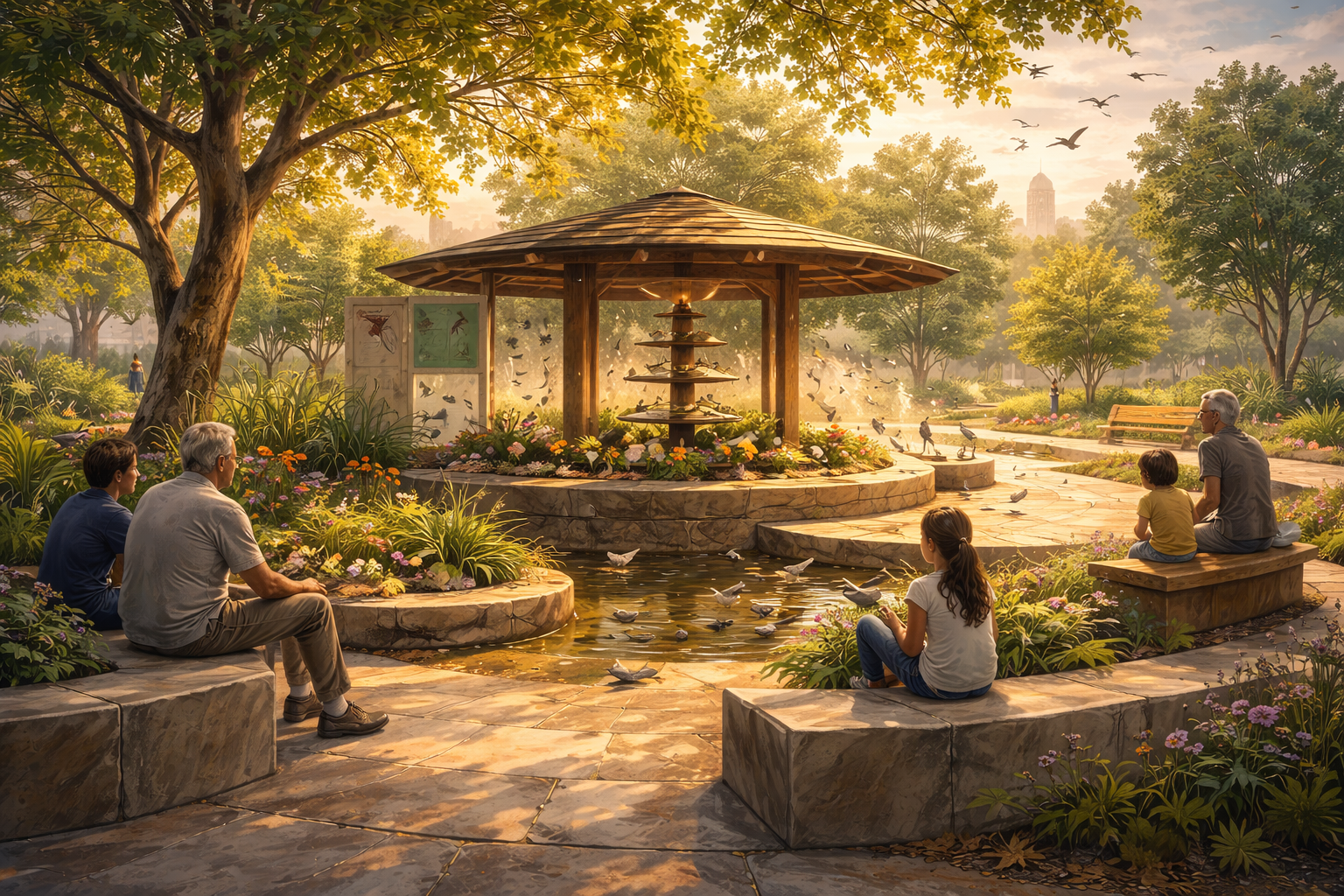
Reframing small acts of care as foundational civic infrastructure for emotional, cultural, and ecological renewal.
The Quiet Infrastructure We’ve Overlooked
Modern societies have become highly efficient at building systems that move goods, data, and capital.
Yet we have largely neglected systems that move meaning, belonging, and emotional continuity.
In this gap, a subtle erosion has taken place.
Public environments have become functional but psychologically thin.
Spaces exist to process people — not to ground them.
Windland’s Bird Feeding Stations initiative begins with a different premise:
that small, consistent encounters with living ecosystems are not luxuries, but stabilising civic mechanisms.
Rather than viewing nature as peripheral decoration, this initiative treats human-wildlife interaction as part of the emotional infrastructure required for resilient societies.
Why Birds Function as Cultural Connectors
Birds occupy a unique position in the shared human imagination.
They move freely across boundaries we construct — physical, social, and symbolic.
They inhabit both wilderness and urban density, adapting without losing their essential nature.
Because of this, birds become living bridges between human systems and ecological continuity.
They are daily reminders that civilisation does not exist in isolation.
In Windland’s framework, feeding birds becomes more than ecological stewardship.
It becomes a repeated ritual of relational awareness — a way for individuals to experience participation in something beyond transactional life.
This reframes coexistence as a lived cultural practice rather than an abstract environmental value.
From Pastime to Structured Civic Practice
Observing wildlife has traditionally been framed as a hobby or leisure activity. Windland’s approach reframes this behaviour as a form of distributed civic participation, embedding ecological awareness into the rhythms of everyday life rather than isolating it as optional recreation.
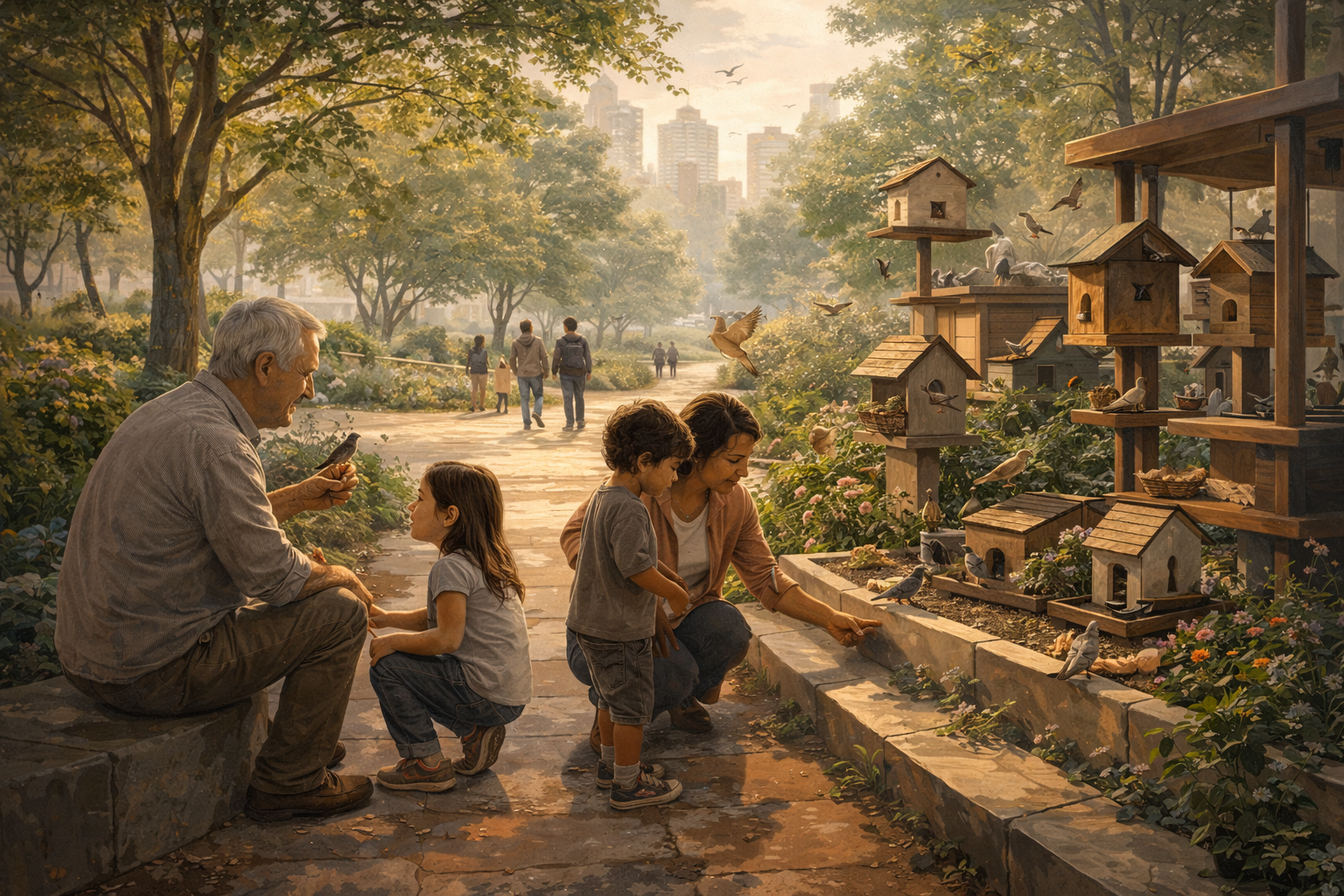
Bird Feeding Stations are conceptualised as intentional micro-nodes designed for integration across public and semi-public environments — from parks and school grounds to transport corridors and shared urban spaces. Each node operates simultaneously across multiple dimensions: providing ecological support to local species, functioning as behavioural learning environments for participants, offering moments of emotional grounding within fast-paced civic contexts, and acting as visible symbols of collective stewardship.
Through repetition and accessibility, these modest yet intentional sites contribute to broader cultural conditioning around care, patience, and interdependence, gradually reshaping how communities perceive their relationship with living systems.
Emotional Regulation Through Environmental Interaction
One of the most overlooked drivers of societal instability is the lack of accessible mechanisms for emotional recalibration.
Natural interactions — particularly predictable, gentle encounters with animals — provide neurological stabilisation benefits that urban environments rarely replicate.
Windland’s Bird Stations are designed to create daily opportunities for micro-restoration.
Moments where individuals pause, observe, and reconnect with rhythms not dictated by urgency.
These repeated experiences gradually reinforce psychological resilience, especially in communities facing economic or social stress.
In this sense, bird feeding becomes a distributed form of preventative mental health infrastructure.
Educational Pathways Embedded in Daily Life
Traditional education models often isolate learning from lived experience, positioning environmental knowledge as theoretical rather than participatory. Windland’s framework integrates environmental education directly into routine civic behaviour, allowing ecological literacy to emerge through repeated interaction rather than abstract instruction.
Bird Stations are structured to function as observational learning platforms where children, youth, and adults engage with processes such as species recognition, habitat awareness, behavioural ecology, and seasonal environmental change. These interactions generate intergenerational learning loops, where practical knowledge is shared organically and stewardship identity develops through lived experience rather than institutional mandate.
Over time, this integration transforms passive environmental awareness into active cultural competency, reinforcing the idea that ecological understanding is not an academic specialty but a foundational civic skill.
Cultural Identity Formation Through Care Practices
Civilisations are defined not only by their economic output but by the rituals they normalise.
When care for living systems becomes a visible and shared behaviour, it begins to shape collective identity.
Windland positions Bird Feeding Stations as symbolic anchors for a culture that values relational responsibility over extractive efficiency.
This is not framed as moral instruction.
It emerges through participation.
By embedding these practices into everyday environments, Windland cultivates a civic ethos where nurturing becomes as culturally recognisable as productivity.

Economic Activation Through Gentle Infrastructure
While rooted in ecological and emotional objectives, the initiative also introduces layered economic pathways that emerge organically from its civic integration. Distributed bird stations create potential opportunity ecosystems across ethical supply chains for feed and materials, artisan manufacturing of habitat structures, digital content environments centred on observation and storytelling, tourism experiences grounded in slow environmental engagement, and educational program licensing frameworks capable of regional and international replication.
Within this model, environmental care becomes economically generative rather than financially burdensome, demonstrating how soft infrastructure can catalyse diversified regional value creation without relying on extractive development logic.
Scaling a Culture of Micro-Stewardship
Windland’s SEEZ framework allows this initiative to scale beyond isolated community projects.
Standardised design templates, behavioural engagement models, and educational integration systems enable replication across regions without losing local identity.
The long-term objective is not merely to install feeding stations.
It is to normalise distributed stewardship as a defining feature of regional development.
When scaled, these networks contribute to broader shifts in how communities perceive responsibility, participation, and shared space.
Reclaiming Small Acts as Structural Forces
Large-scale transformation is often imagined as the result of monumental projects or disruptive innovation.
Yet cultural evolution frequently begins through the repetition of small, meaningful behaviours.
Windland’s Bird Feeding Stations demonstrate how modest interventions can generate cumulative systemic change when embedded into civic design.
Feeding birds becomes a symbolic act — one that reintroduces reverence into daily life while reinforcing ecological continuity.
Through this initiative, care itself becomes infrastructure.