Why More Money Won’t Solve Anything—But More Wisdom Will

Wealth amplifies systems. It does not repair them.
The Persistent Myth of Financial Rescue
Across societies, economic difficulty is often framed as a simple resource deficit. When institutions struggle, when communities decline, or when individuals face hardship, the proposed solution frequently centres on increasing financial input. More funding. More investment. More liquidity.
Yet history repeatedly demonstrates that financial expansion alone rarely resolves structural problems. In many cases, it intensifies them. Without clarity of purpose, cultural maturity, and institutional intelligence, additional wealth becomes fuel for existing dysfunction rather than a catalyst for transformation.
Money changes scale. It does not change design.
Wealth as an Amplifier of Existing Conditions
Financial resources operate as multipliers. In environments already shaped by discipline, strategic thinking, and long-horizon planning, increased wealth accelerates growth and stability. In environments defined by short-termism, reactive governance, or cultural fragmentation, the same influx of capital can magnify volatility.
This amplification effect is visible across multiple domains. Organisations with strong leadership cultures utilise capital to expand capability. Those without such foundations may instead experience rapid expansion followed by equally rapid collapse. Nations rich in natural resources often struggle with governance complexity, while knowledge-driven economies leverage comparatively modest resources into sustained prosperity.
The determining factor is rarely the amount of money. It is the maturity of the system receiving it.
Cultural Infrastructure Precedes Economic Power
Economic strength is typically the outcome of deeper societal conditions rather than its origin. Education systems, social norms, leadership expectations, and institutional trust collectively shape how financial resources are interpreted and deployed.
Where cultural infrastructure supports accountability, curiosity, and disciplined execution, financial investment tends to translate into durable value. Where such infrastructure is absent, capital can become a destabilising force, encouraging speculation, corruption, or unsustainable growth patterns.
In this sense, culture functions as the operating system of economic life. Financial capital is merely an application layer.

The Misinterpretation of Prosperity
Short-term financial success can obscure underlying fragility. Periods of rapid growth may create the appearance of systemic health even when foundational weaknesses remain unresolved. When conditions change — through technological disruption, geopolitical shifts, or market recalibration — these weaknesses often become visible.
This pattern contributes to cycles of boom and correction across both corporate and national contexts. Prosperity achieved without parallel development of institutional intelligence can prove difficult to sustain.
Wisdom, unlike capital, compounds through disciplined application rather than accumulation.
Education, Innovation, and the Long Horizon
Societies that consistently outperform economically tend to invest heavily in knowledge ecosystems. Research capacity, educational accessibility, and innovation culture create adaptive resilience. Such systems are capable of reinterpreting challenges as design opportunities rather than existential threats.
This orientation shifts the role of money from a perceived solution to a strategic instrument. Financial resources support experimentation, infrastructure development, and collaborative problem-solving rather than acting as substitutes for them.
The difference lies in whether wealth is treated as an endpoint or as a tool.
Leadership as the Mediating Variable
The impact of financial power is ultimately mediated by leadership quality. Leaders influence how resources are prioritised, how risks are interpreted, and how societal narratives around success and failure are constructed.
Where leadership emphasises principled stewardship, financial growth can translate into expanded social capacity. Where leadership is driven by optics, short-term incentives, or defensive policymaking, wealth may reinforce inequality and institutional mistrust.
In this way, wisdom functions as an invisible governance mechanism shaping the trajectory of economic outcomes.
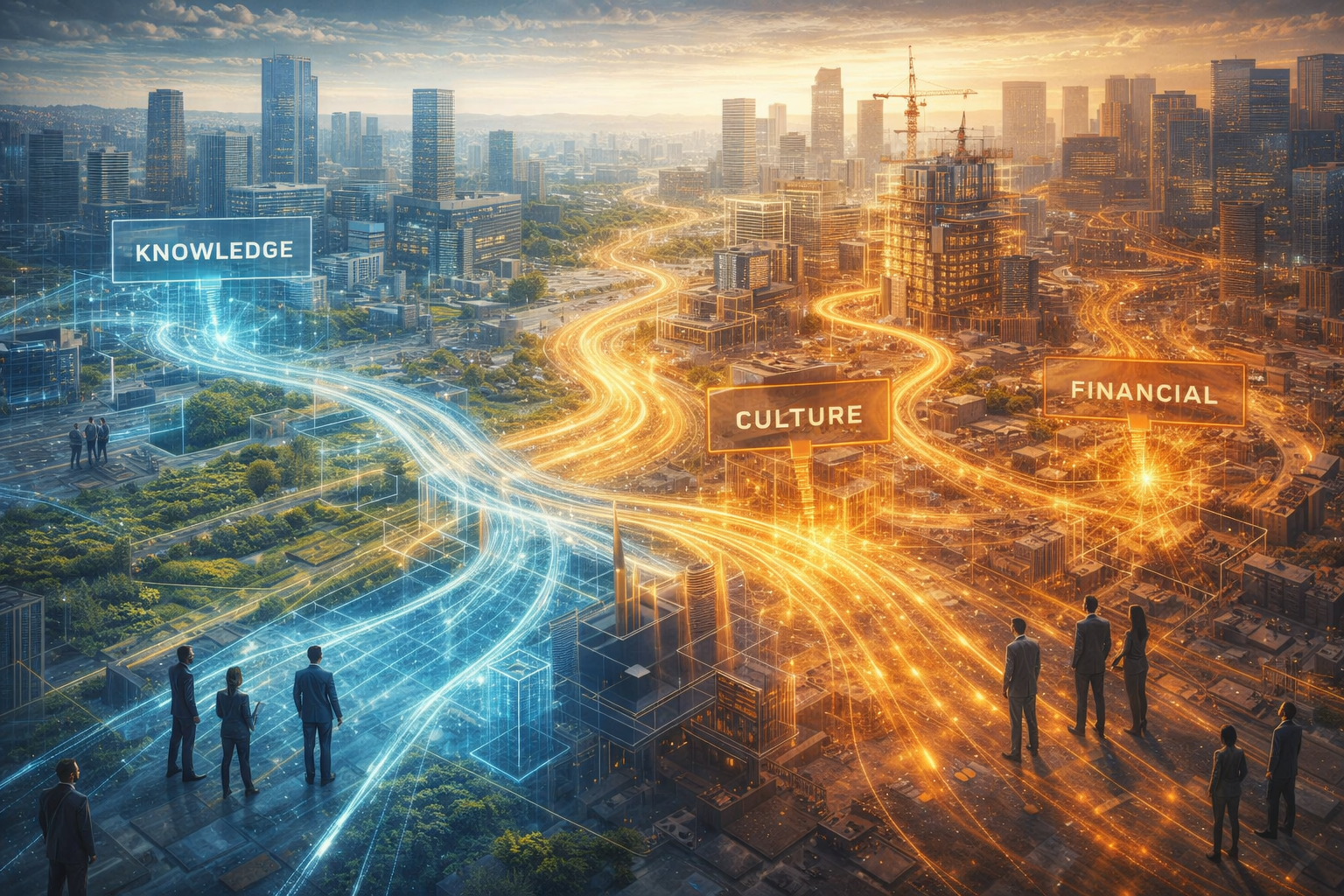
Structural Design Over Financial Volume
Effective systems prioritise clarity of design before scale of funding. This includes governance frameworks capable of managing complexity, economic models aligned with long-term productivity, and cultural narratives that reward contribution rather than extraction.
When structural design is neglected, financial injections can create temporary relief without addressing systemic inefficiencies. Conversely, well-designed systems often attract capital organically, as confidence in their stability and purpose increases.
Money follows coherence more reliably than coherence follows money.
Rethinking Prosperity in an Interconnected World
In an increasingly integrated global environment, the relationship between wisdom and wealth carries broader implications. Economic decisions made within one system can influence stability far beyond national boundaries. This interconnectedness elevates the importance of strategic maturity in financial governance.
Societies capable of aligning financial capability with ethical foresight are better positioned to navigate complexity. Those that treat wealth as a primary solution risk perpetuating cycles of reactive adjustment.
Toward a Wisdom-Led Economic Paradigm
Reframing prosperity requires shifting emphasis from accumulation to application. Financial resources remain essential, yet their effectiveness depends on the intellectual and cultural ecosystems in which they operate.
By prioritising education, institutional design, and principled leadership, societies can transform wealth from a volatile variable into a stabilising force. In this paradigm, money becomes a facilitator of human development rather than its assumed driver.