Run Toward the Storm: The Counterintuitive Path to Resolution

Why meaningful transformation begins where avoidance ends.
The Culture That Teaches Us to Look Away
From an early age, most people are conditioned to interpret discomfort as failure. Pain is framed as something to eliminate quickly, conflict as something to smooth over, and uncertainty as something to escape. We are trained to maintain appearances, to keep moving, to function regardless of what is unresolved beneath the surface.
This cultural reflex toward avoidance is understandable. Stability appears easier when difficult realities are postponed. Yet this collective habit creates environments where unresolved tension accumulates silently. The result is not peace, but pressure — internal and external — that shapes behaviour long after the original moment has passed.
Avoidance becomes a social norm. And norms eventually become invisible.
When the Unresolved Begins to Shape Reality
Experiences we refuse to confront do not simply fade. They reorganise themselves into patterns of reaction, expectation, and perception. Over time, these patterns influence relationships, decision-making, and identity itself.
A person may believe they are responding to present circumstances, when in fact they are responding to echoes of unresolved past dynamics. The same is true at larger scales. Organisations and societies often repeat cycles of dysfunction not because they lack solutions, but because they have not examined the roots of their recurring tensions.
What remains unexamined becomes structural.
What becomes structural begins to feel inevitable.
The Intelligence Hidden Inside Difficulty
Every persistent challenge contains information. Pain is rarely random. Recurring conflicts, stagnation, or emotional friction are signals that something within our systems — personal or collective — requires recalibration.
To understand difficulty as intelligent rather than punitive is a significant shift. It transforms adversity from an enemy into a diagnostic tool. When approached with curiosity rather than fear, discomfort reveals patterns that would otherwise remain hidden.
This reframing does not romanticise suffering. It recognises that understanding is a prerequisite for meaningful change.

The Counterintuitive Turn Toward Engagement
Resolution rarely occurs through distance alone. In many cases, meaningful progress requires proximity — not immersion in chaos, but deliberate engagement with what has been avoided.
Turning toward difficulty allows us to observe its mechanics. We begin to recognise triggers, feedback loops, and behavioural responses that sustain the very conditions we wish to escape. What once felt overwhelming becomes interpretable.
Engagement replaces speculation.
Understanding replaces projection.
This is the moment where transformation becomes possible.
Observing From Within Without Being Consumed
One of the most advanced personal capabilities is the ability to remain present inside complexity without losing perspective. This involves cultivating emotional regulation, reflective awareness, and strategic patience.
When individuals learn to observe challenges from within, they move beyond reactive survival patterns. They develop the capacity to respond with intention rather than instinct. Over time, this skill reshapes not only their internal world but the environments they influence.
Mastery is not the absence of storms.
It is fluency in navigating them.
Redefining Courage as Sustained Honesty
Courage is often portrayed as dramatic or forceful. In practice, it is more frequently expressed through sustained honesty — the willingness to remain engaged with difficult realities even when resolution is uncertain.
This form of courage requires faith in process rather than immediate outcome. It demands the discipline to continue asking better questions, even when definitive answers remain out of reach.
Such courage is quiet, but it is transformative. It shifts the trajectory of lives and systems alike.
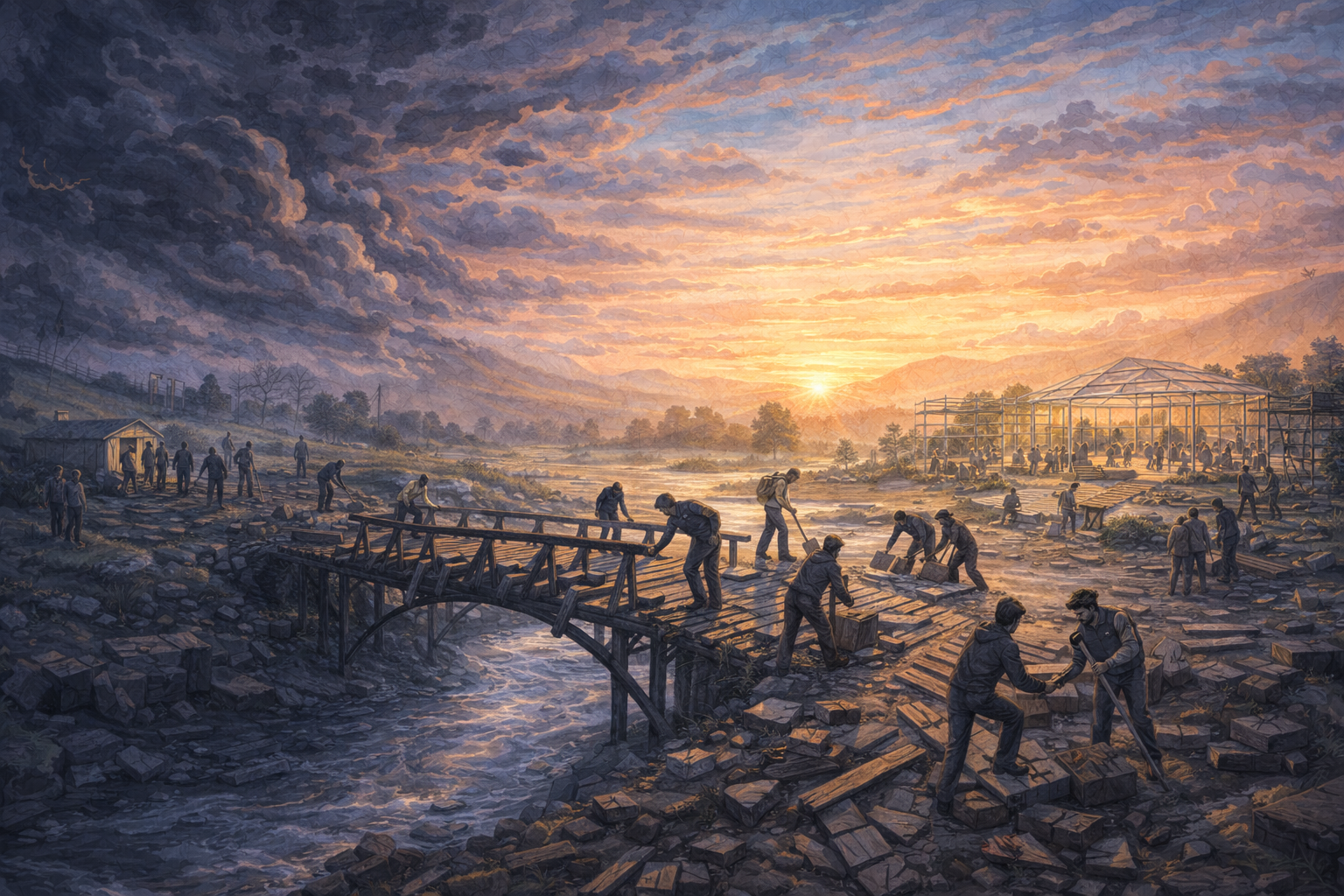
Developing Resolution as a Transferable Skill
Resolution is not a singular event but a repeatable capability. Skills such as emotional literacy, systemic thinking, and reflective inquiry enable individuals to engage constructively with complexity.
When cultivated intentionally, these capabilities become transferable. They influence leadership styles, organisational cultures, and community dynamics. Individuals who understand how to move through difficulty become stabilising forces within uncertain environments.
This is where personal development intersects with systemic resilience.
From Personal Storms to Collective Evolution
When individuals learn to engage with unresolved tensions constructively, the ripple effects extend outward. Families experience fewer cycles of escalation. Organisations adapt more intelligently. Communities develop greater tolerance for complexity without collapsing into fragmentation.
Collective progress depends on the capacity of individuals to face reality rather than flee from it. The more this capability spreads, the more resilient societies become.
Transformation at scale begins with transformation in practice.
The Path Through, Not Around
Avoidance promises relief but often delivers repetition. Engagement, though uncomfortable, offers the possibility of resolution.
Running toward the storm does not mean seeking hardship. It means recognising that growth frequently requires contact with what is difficult to understand. By choosing engagement over evasion, individuals develop the clarity and strength required to move beyond recurring constraints.
The path forward is rarely linear.
But it becomes visible the moment we stop looking away.