Meet the Booties.
Every name belongs to a life. Explore the residents, their relationships and the stories they leave with us.
Get to know the different birds
The resident profiles are listed below.
You can still open the resident profiles in the list below.
About the birds.
A little background on the different birds who call the Manor home.
Budgerigars
Budgerigars are small Australian parrots. Wild budgies are green and yellow with dark markings; generations of domestic breeding have produced the blues, whites and other colours familiar in homes and aviaries.
They are flock birds whose calls help them stay in contact. At the Manor, Clover brings his own enthusiasm to the conversation.
Meet the budgiesRead more: BirdLife Australia
Scarlet-chested parrots
These small Australian parrots have soft calls and often feed close to the ground. Their blue faces and yellow underparts are striking; the scarlet chest that gives the species its name belongs to the male.
Ralphie is one of the Manor’s scarlet-chested parrots. His sleeping enclosure, Emerald Perch Paradise, also attracts a regular daytime gathering of budgies.
Meet the parrotsRead more: NSW species profile
Zebra finches
Zebra finches are sociable grassfinches found across much of Australia. Their short contact calls can keep a flock sounding busy even when everyone is sitting still.
In the familiar wild colouring, males have chestnut cheek patches and patterned flanks. Domestic colours vary, so the individual resident photographs are the best way to get to know the Manor’s birds.
Meet the finchesRead more: Australian Museum
Gouldian finches
Gouldian finches come from tropical northern Australia. Their distinctive plumage combines strong blocks of colour, and their faces may be black, red or yellow.
Young birds begin with much quieter colours. Their brighter adult plumage develops as they mature—a transformation that gives a family album something special to follow.
Meet the finchesRead more: Australian Museum
Society finches
Also called Bengalese finches, society finches are domesticated birds with a long history in aviculture. They come in varied colours and patterns, including brown, white and pied forms.
Their sociable nature is especially noticeable at roosting time, when a group may settle closely together. Here, as with every resident, the individual relationships are part of the story.
Meet the finchesRead more: National Finch & Softbill Society
Painted finches
Painted finches are also known as painted firetails. Their dark underparts carry fine white spots, with red on the face and across parts of the breast and belly.
Adult males usually have more extensive red facial markings than females. Look closely at the resident portraits and the differences become part of recognising each bird.
Meet the finchesRead more: Australian Bird Study Association (PDF)
Red-billed firefinches
These small African finches are also known as Senegal firefinches. Adult males have rich red plumage with brown wings, while females are much browner.
In the wild they often forage on the ground for grass seeds. Their appearance is quite different from the Australian painted finches, despite the similar-sounding names.
Meet the finchesRead more: Tulsa Zoo · Biodiversity Explorer
Canaries
The Manor’s canaries include yellow birds and Glosters. Gloster is the name of a domestic canary breed, rather than a separate species.
Glosters have two forms: the Corona has the familiar rounded feather crest, while the Consort has a plain head. Both belong to the same breed.
Meet the canariesRead more: Gloster Fancy Canary Council International
King quails
King quails are small ground-dwelling birds, also known as Asian blue quails or Chinese painted quails. Their wider range extends through parts of Asia to Australia.
They spend much of their time moving through low cover. While other residents explore the branches, quails offer a different view of life closer to the ground.
Meet the quailsRead more: SWIFFT species profile
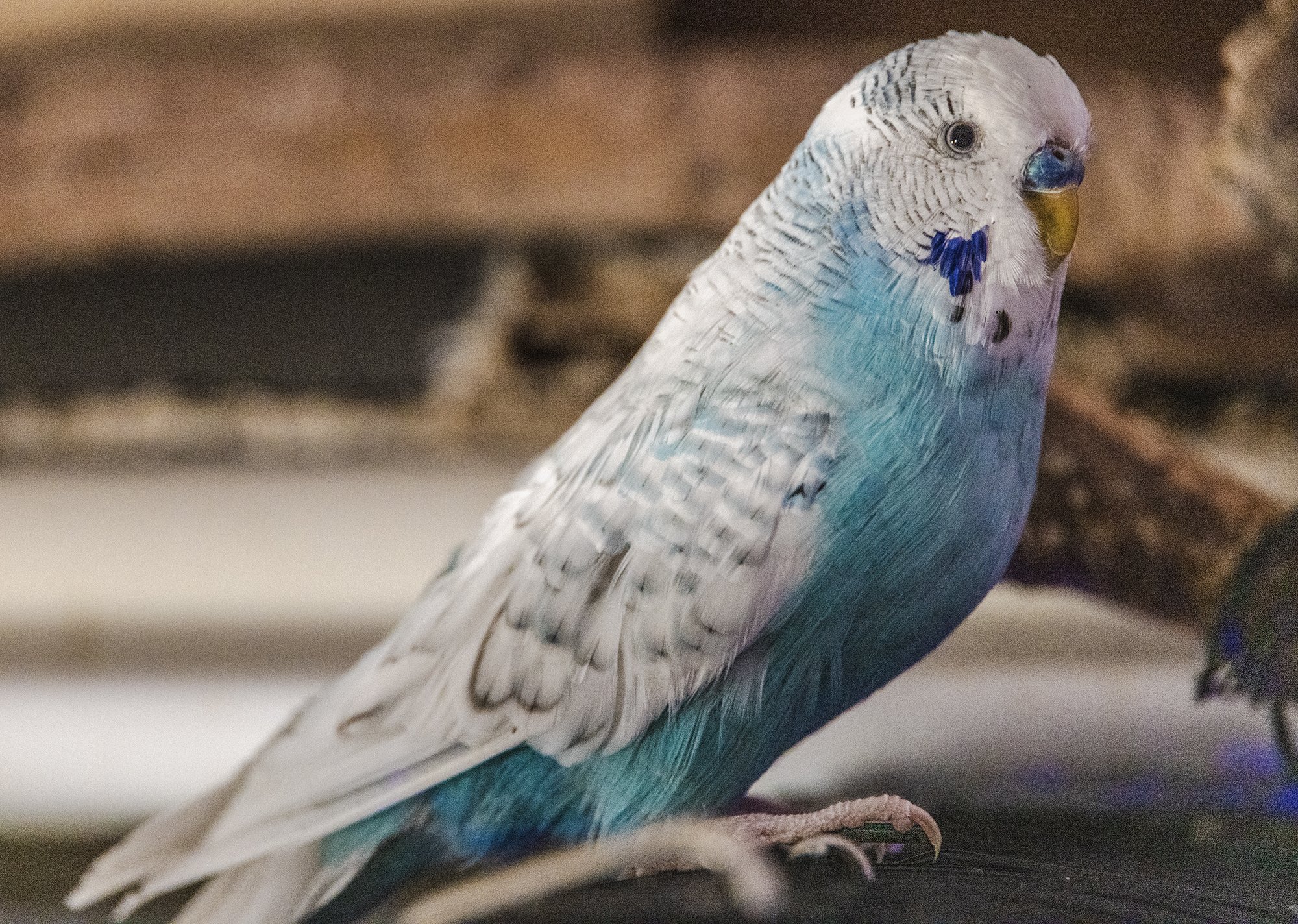
Clover Bootie
Meet Clover Bootie, Fluffington Manor’s friendly budgie, always ready for a conversation and curious about what everyone else is doing.