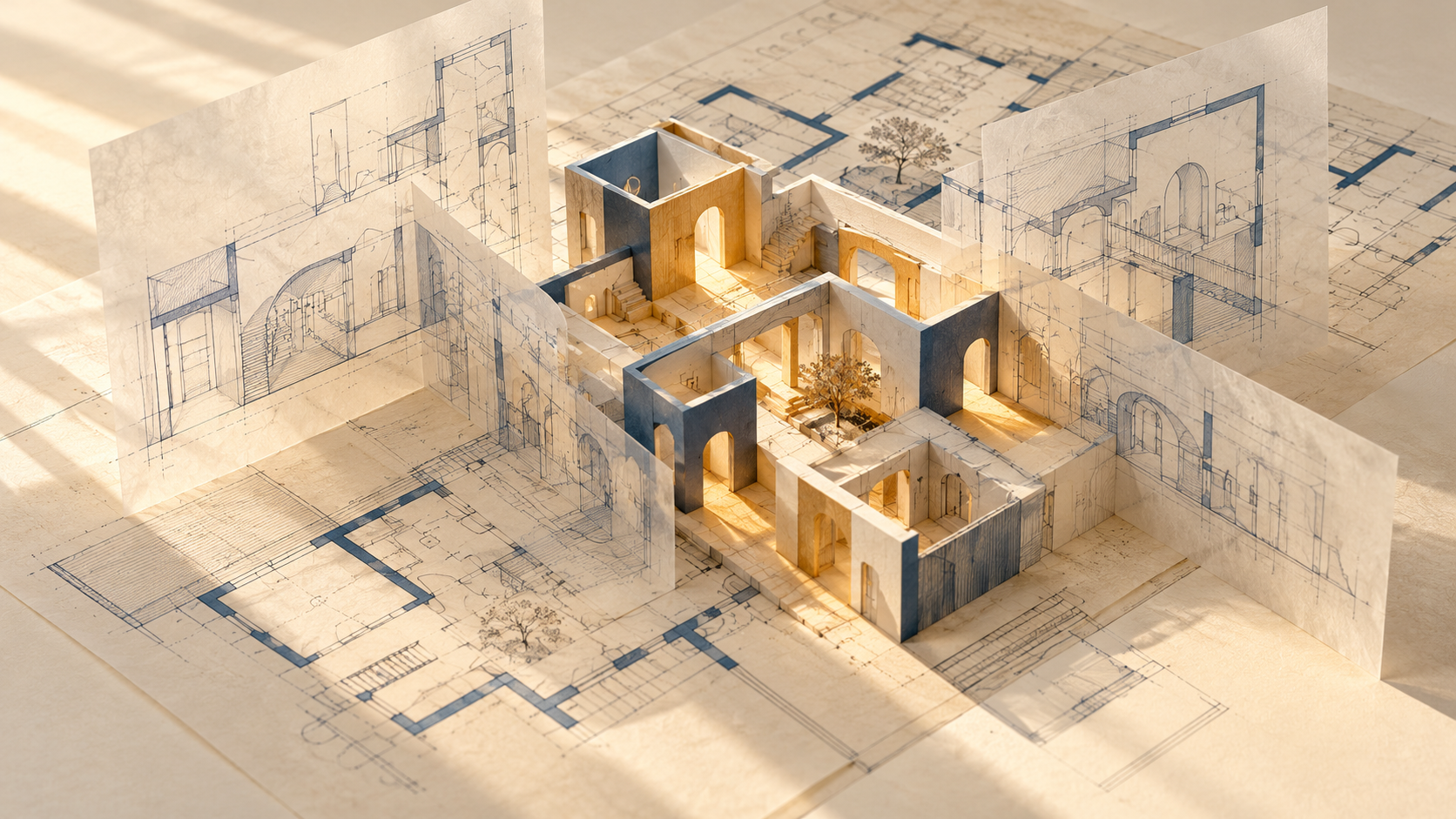
MAKING THE WORK EASIER TO SEE
Platform & Infrastructure
Making the Work Easier to See

There has been a gap in these entries since July. During that time, the work has continued across the proposals, frameworks, films, correspondence and public pages. Much of my attention has gone into developing that material and making it easier for someone arriving for the first time to understand.
When the same person is developing the work and documenting it, those demands compete for time. The public record will become more regular as there are people to help maintain it. For now, this entry brings one important part of the recent work back into view.
The recurring question has been simple: how does someone else find their way into something I have spent years building?
Knowing the work from the inside can make that question surprisingly difficult. I know why one framework connects to another. I know which document explains a particular decision, where an earlier idea has developed, and how the different parts are intended to function together. A new reader has none of that history.
They need an introduction that gives them enough understanding to take the next step. Creating that introduction has become a substantial part of the build.
The reader does not start where the founder stands
A government reader may begin with the proposed acquisition, the public return and the responsibilities involved. Someone considering Club GSM may want to understand what membership could bring into their business and their life. A person encountering Human Response Architecture may recognise a problem they have experienced and want to know how a different response would work.
Each arrives with a legitimate question. Each needs a useful place to begin.
Putting the entire body of work in front of them does not necessarily answer that question. A document can be comprehensive and still leave someone unsure why it matters to them. A page can contain the relevant information while making the reader work too hard to find it.
The responsibility is to create an understandable route through the material: an opening that establishes the purpose, an explanation that shows the value, and a clear way to examine the detail.
The depth should remain available. The reader should be able to reach it without first having to reconstruct the founder’s thinking.
The work of the last few months
The government financial return material has brought the proposed revenue partnership into sharper focus: where the receipts would come from, how the allocation would work, who would receive a share, and how the proposed sales and payment programme fits together. The model and partnership briefings give the wider architecture and the acquisition decision their own space, with films and supporting papers providing further explanation.
The Human Response Architecture material has developed the connection between understanding a person’s circumstances, reorganising the conditions around them, and restoring their capacity to participate in life. Its public presentation brings the foundation, response architecture and institutional transition work into a more connected account.
Club GSM has needed its own explanation of membership: what a Key secures, how programmes and destinations develop, and how a person’s involvement can grow with their ambitions, capabilities and relationships.
Alongside that, the websites have been revised to help people navigate the work, distinguish its different purposes and reach the material relevant to them. The Alignment Log has also been reorganised into a consistent monthly record, giving the development a clearer chronology.
These changes are practical. They affect whether someone can understand the proposal, locate their interest, share a useful reference with another person, and return later without losing their place.
Clarity requires decisions
Making a page clearer often means deciding what its first job actually is.
What does the reader need to understand before a figure makes sense? Which relationship needs to be explained before a framework name becomes useful? Where should a short introduction end and a detailed paper begin? What should someone be able to do after reading?
Those questions reach back into the work itself. An explanation can expose a missing connection, an assumption that has remained inside my own head, or a sequence that needs to be stated more precisely. Revising the public material becomes another way of examining the structure beneath it.
Presentation matters within that process. Headings, spacing, images, films and navigation influence how easily a person can follow an explanation. They deserve attention because they affect the experience of reading. Their purpose is to help the substance become more accessible and more accurately understood.
I want someone to finish a page with a clearer understanding of what is being developed, why it could matter, and where to go next.
A clearer basis for engagement
The architecture behind this work is already developed across a substantial body of frameworks, proposals and supporting material. Bringing it into operational and physical form requires the resources, teams and partnerships to carry it forward.
The public material needs to make that relationship understandable. A reader should be able to distinguish what has been developed, what the next decision would enable, and how the wider programme is intended to unfold.
That makes engagement more useful. People can examine a specific proposition, identify where they have expertise or an interest, and ask questions that move the discussion forward. A government office, prospective partner or potential member should have enough context to understand the invitation being made to them.
Clearer communication creates a better basis for that conversation. The next stage still has to be built through decisions, resources and sustained work.
A record that people can return to
Field Notes gives me room to explain what I am learning through the build. The Alignment Log carries the monthly record. The public pages introduce the work, while the papers and briefings allow closer examination.
Those different forms have distinct jobs. Together, they should help someone follow the development without needing to have been present for every step.
That is what this period has been moving towards: a body of work that is easier to enter, easier to examine and easier to carry into a conversation with someone else.
The next task is to use that clearer foundation in the engagement and decisions that can bring the work into operation. Alongside it, I will continue recording the moments that reveal something useful about the process.
Someone arriving today should be able to find a starting point. Someone returning after several months should be able to see what has moved. Someone who recognises a role for themselves should be able to find a way to discuss it.
Making those connections possible is part of building the work.
With this entry
Accompanying materials.
The architecture, the human response and the development record.
GSM — Vision & Frameworks
Explore the frameworks and systems behind the wider body of work, and how they relate to its proposed application.
Explore vision & frameworksA New Era of Human Response
The foundation, response architecture and institutional transition materials connecting understanding, conditions and human capacity.
Explore Human Response ArchitectureThe Alignment Log
The monthly record of GSM’s continuing development, with reports and supporting material.
Read the Alignment Log