The Weight and the Wonder: Rebalancing What It Means to Care

Why responsibility should expand access to joy — not replace it.
The Version the World Tries to Shape
There is always a version of us that external pressure attempts to mould.
Fatigue. Repetition. Quiet disappointment.
These forces rarely arrive as dramatic events. More often, they reshape us slowly — through accumulation.
People adapt to weight because they must. Not because they lack strength.
But over time, constant adaptation has consequences.
Joy begins to narrow. Hope contracts. Responsibility starts to feel less like contribution and more like sentence.
When care becomes indistinguishable from burden, something essential in the human spirit begins to close.
Yet another path remains possible — one that begins by questioning the assumption that life must be carried alone.
Disillusionment as a Signal
Disillusionment is often treated as failure. In reality, it can be information.
It is the moment when reality interrupts expectation.
A signal that something about the current arrangement cannot continue indefinitely.
The danger arises when disillusionment stops being a temporary insight and becomes a permanent worldview.
When people begin to believe that effort changes nothing, participation quietly declines.
Cynicism then reinforces the very conditions that produced it.
Rebalancing responsibility therefore begins with emotional recalibration.
Disillusionment must be recognised as data — not identity.
The Emotional Economy of Responsibility
Modern societies distribute labour unevenly.
But they also distribute emotional weight unevenly.
Some individuals become stabilisers by default — holding families, organisations, or communities together without corresponding access to restoration or recognition.
Over time, this imbalance erodes resilience.
A sustainable system understands that responsibility and renewal must coexist.
Effort without replenishment leads to collapse.
Effort paired with meaning becomes stabilising.
This is not idealism.
It is structural reality.

Integrating Weight and Wonder
Cultural narratives often position responsibility and joy as opposites.
Hardship is framed as noble. Fulfilment is framed as reward.
This division creates a narrow pathway where contribution requires personal diminishment.
A healthier model integrates the two.
Taking on difficult roles would not remove access to beauty or creativity.
Instead, responsibility would deepen one’s relationship with meaning.
Contribution would become experiential rather than deferred.
Not something endured now in exchange for life later — but something lived fully in real time.
The Social Power of Shared Burden
When responsibility becomes more evenly distributed, systems begin to shift.
Burnout reduces.
Participation expands.
Trust grows.
People observe that effort produces shared benefit rather than isolated depletion.
Over time, cultural narratives begin to evolve.
Future generations no longer associate responsibility with invisibility.
They associate it with agency.
This is where structural change often begins — not in policy, but in perception.
Redefining What It Means to Care
Historically, care has been framed as sacrifice.
While sacrifice has its place, systems built entirely on sacrifice eventually exhaust their most committed participants.
A more sustainable definition recognises that sustaining others requires sustaining oneself.
This reframing expands participation.
People who feel recognised and supported are more willing to take on demanding roles.
Care becomes reciprocal rather than unilateral.
An exchange that strengthens both giver and receiver.
Designing a New Social Contract
Thriving societies embed dignity into participation.
They recognise that essential work — especially unglamorous work — must not result in social invisibility.
They design environments where contribution does not remove access to joy.
Such systems are not utopian.
They are pragmatic.
Collective stability depends on sustainable engagement.
When individuals experience meaning alongside effort, long-term investment in shared outcomes becomes possible.
The result is not simply reduced strain.
It is expanded potential.
When Shared Effort Becomes Shared Renewal
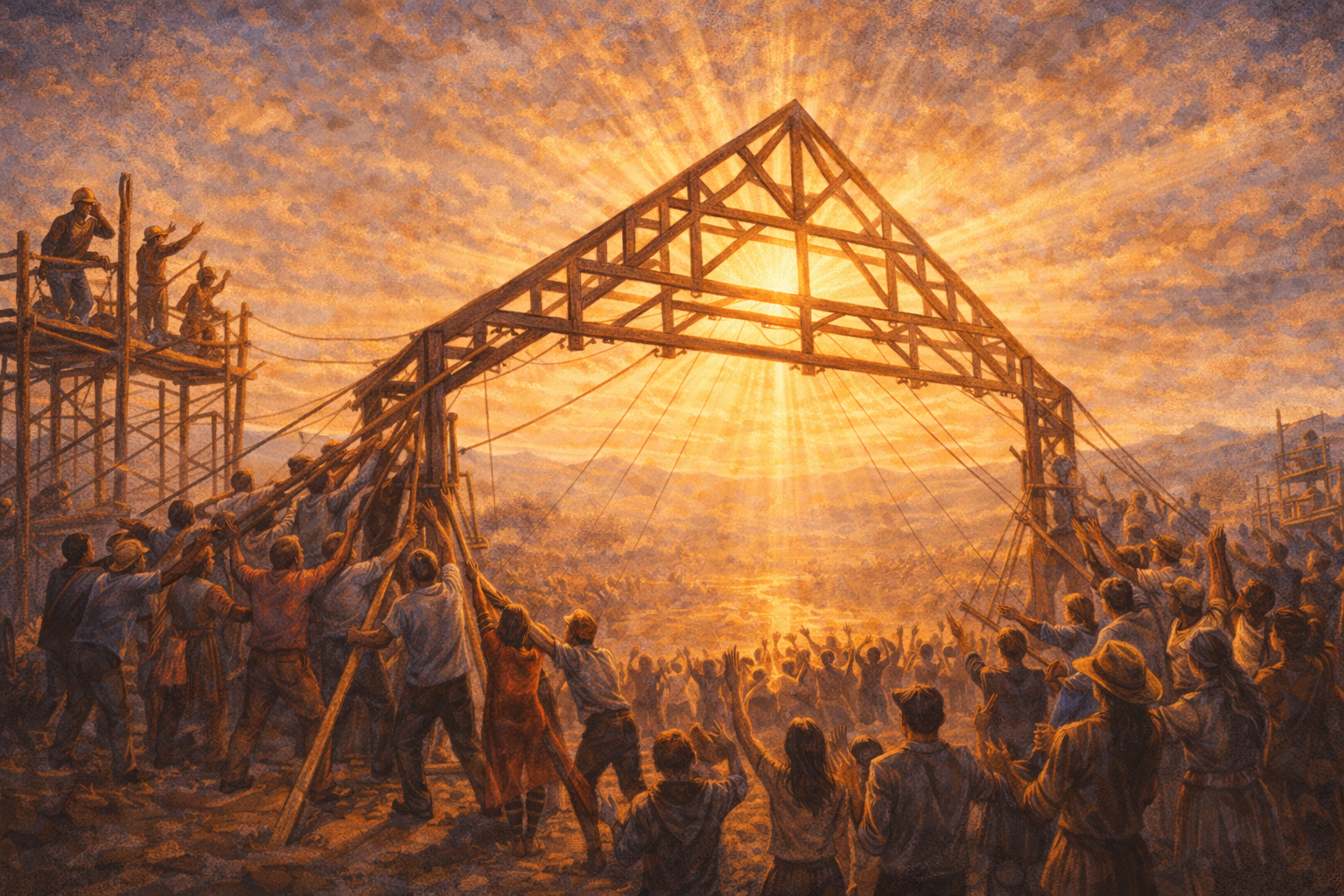
As more people participate in carrying societal weight, the perceived heaviness changes.
Burden does not disappear.
It becomes distributed.
Through distribution, endurance transforms into vitality.
Societies evolve not because responsibility vanishes, but because it is held differently — with enough care, creativity, and mutual recognition to transform obligation into shared purpose.
The future will not be shaped by those who escape responsibility.
It will be shaped by those who learn to balance its weight with wonder.